Part 2 of 4 – Practicing Meditation & Living Mission-Driven
5. Meditation
Taking your seat and coming into being, rather than doing, is a radical act of sanity and a radical act of love. -Jon Kabat Zenn
The truth is that distraction is an internal reality, not an outward event. Both Jesus and Peter stood on water while the tempest raged, but only Peter was distracted by the storm (Matt 14:30). Moreover, we can sit in silence far from the madding crowd and yet be wholly caught up in the maelstrom of our minds.
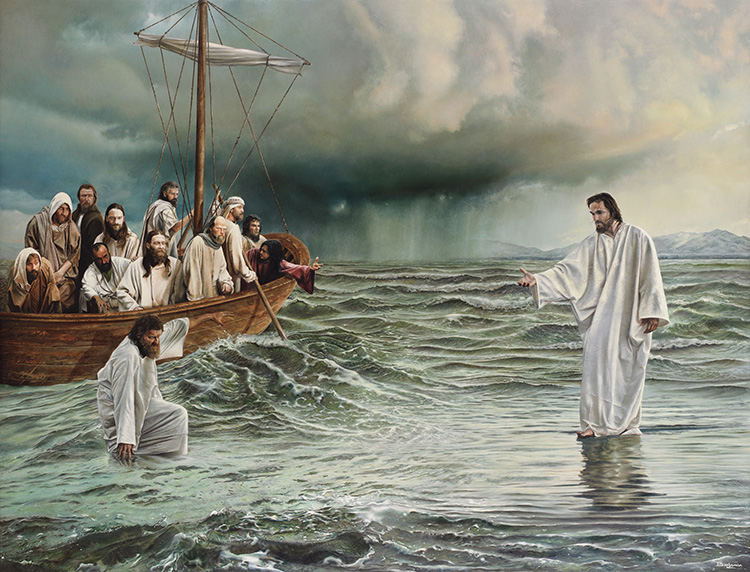
Note Peter’s gaze. Like the citizens in Rockwell’s painting, his gaze is cast downward toward the sea while the very Creator stands before him.
The onslaught of thought-distraction is relentless and inescapable. We can flee to the mountains, but our minds come with us, and the untrained mind brings a chaos of its own.
To help us combat our frenzied minds, Jesus commands us to “Be still” (Ps 46:10; D&C 101:16; Mark 4:39), and it may be the least kept commandment. In fact, stillness is so foreign to us that we relegate its reality to either Eastern religions or woke retreats, even while in the West, we live infamously distracted lives!
If we look to these two groups, however, we learn something—stillness is less a state of being as it is a discipline of practice. We cannot “be still” any more than we can “be perfect,” and so Jesus is more likely inviting us not into a state of stillness but into a ritual practice of it.
Jesus knew that when our minds are stilled, we exercise our agency better. We can make decisions based on faith and clarity rather than on fear and anxiety, acting rather than being acted upon (2 Ne 2:14). Peter “saw” the storm but he was blind to the reality that God himself, Master of wind and wave, stood right in front of him—a reality that was so obvious to Jesus’ stilled mind that he chided Peter for having so little faith. When the disciples were terrified for their lives during a similar but different storm, they couldn’t see past their “little ships” (Mark 4:36).

Like Peter and the disciples, we too get quickly caught up in the tumultuous moments of life. In short, we are not well practiced in stillness. On occasion we get momentary glimpses of clarity amid chaos, as when Peter briefly walked on water, but we quickly lose sight when anxiety-laden thoughts hijack our poorly trained minds.
The good news is that all of us can cultivate a quiet and conscious mind. I suggest that just as Jesus’ command to ‘be perfect’ is an invitation into the practice of repentance, so his command to ‘be still’ is an invitation into the practice of meditation. I began this essay arguing that discipline comes not from willpower but from doing simple things often. Like prayer, scripture study, sacrament, and temple-attendance, meditation is the perfect simple practice that can yield enormous spiritual benefits.
The most common form of meditation is mindfulness, or “breath meditation,” in which we bring our attention to our breathing. There are myriad mobile apps that do daily, guided meditations, commonly for 10-20 minutes; but the key is consistency, not duration, like watering a plant a little every day.
To practice, you sit quietly with solid posture and bring your awareness to an anchor, typically your breath, and invite your mind to rest there. Soon you will notice your mind begins to wander, and each time you notice it wandering, notice where it goes, and then gently guide your awareness back to your anchor. That’s it!

That’s all we’re doing at least, but what’s happening is something more. The moment we notice our thoughts wandering, we have suddenly separated ourselves from those thoughts and entered mindfulness. Now that our thoughts are externalized, we can observe and understand them objectively and nonjudgmentally. They have no more power over us, but they can be useful in teaching us. We can control them rather being controlled by them. As we then bring our awareness back to our breath, we build the muscle of focus and concentration. As we do it gently and kindly, without criticism, we learn self-compassion. As the pattern repeats, we gain insight into our mind’s habits, what draws us away, giving us wisdom and self-understanding. Our posture alone, fixed but relaxed, models how we ought to approach life—squarely, honestly, and compassionately. Even more elementary, the very act of choosing to practice, to do “nothing,” cultivates patience and a resistance to compulsions. And if all that weren’t enough, meditation can actually change our brain structure, modifying for the better key neural networks and pathways involved in stress, focus, attention, memory, and mood.
In a bit of a deeper dive, below are three things meditation IS NOT and six things meditation IS.
1. Meditation IS NOT a way to become calm and serene. It isn’t a form of relaxation. We’re not trying to relax but rather to be more present. It isn’t about avoiding painful emotions or physical irritations, but instead connecting fully to these without magnifying them.
2. Meditation IS NOT prayer nor pondering. Prayer is when we speak or divulge while meditation is when we are silent and listen. Pondering is when we think deeply about a subject while meditation is when we empty our minds of thought. Each is important to spirituality, but meditation has a silent quality that honors the art of receptivity. When we meditate, it becomes possible for us to hear the universe as it speaks for itself, responds to our questions, or sits with us in silence.
3. Meditation IS NOT repentance nor seeking improvement. In fact, it’s the very opposite. In the realm of meditation, practicing in order to improve ourselves is a form of aggression—the idea that what we are isn’t enough. Meditation cultivates benevolence and commits us to open ourselves up fully to what we are with genuine tenderness. “The goal of meditation practice is not to reject ourselves and become better. Its aim is to make us friends with the person we already are.” (Pema Chödrön) This realization provides a deep sense of relief.

1. Meditation IS being present. Jesus taught his disciples to, “take therefore no thought for the morrow: for the morrow shall take thought for the things of itself. Sufficient unto the day is the evil thereof.” (Matt 6:34) Later, when his disciples were “terrified and affrighted” at Jesus’ ghostly resurrected appearance, he asked them not only why they were troubled, but “why do thoughts [worries] arise in your hearts? (Luke 24:38) The purpose of meditation is to divest ourselves of ‘thoughts.’ The spontaneous and disconcerting thoughts that arise in our hearts and terrorize our minds are typically ones of past wounds or future fears. The goal of meditation is to focus on the now, to deal with what is and not what was or what might be.
2. Meditation IS paying attention. Our agency is limited by what we cannot see, and we cannot see what we do not pay attention to. To be mindful and to meditate is to learn how to pay attention. Mindfulness is simply waking up, and the practice of meditation is, in a way, putting into practice all the prophetic invitations to “awake” (Is 51:9; 52:1; 2 Ne 1:13) that we might truly see, hear, and understand (Matt 13:15). Attention means fully realizing what we are doing, and meditation is an apprenticeship on attentiveness. It trains us how not to miss Rockwell’s doves or Burrough’s birds. (Racked & Distracted 1)
3. Meditation IS seeing things as they are. In southeast Asia, meditation is often called vipassana, a Pali word that means “seeing things as they really are.” True meditation is discernment—it is learning to see what is, as it is; and to see ourselves as we are. In scriptural terms, it is coming to a knowledge of the truth (Jacob 4:13; D&C 93:24). Or as Paul taught, “knowing even as also I am known” (1 Cor 13:12). Meditation brings us to self-knowledge. Consequently, it’s not a pleasure trip—we’re bound to confront aspects of ourselves that we would rather not know. But if we want to weaken their power over us, we have to face them and learn to be in wise relationship with them, with our life as it is, including its shadows. True wisdom lies not in being perfect but in being fully human, and meditation teaches us how to see and face our humanity.
4. Meditation IS acceptance and self-compassion. Seeing the truth isn’t enough. We must also accept it. The heart of meditation practice is radical acceptance of the truth. To accept does not mean being happy with everything but to be open to what is and to receive it before defining the right thing to do. This kind of acceptance provides serenity, but we must be willing to be completely ordinary people. If we can accept our imperfections with calm and compassion, we can use them as part of the path, not toward perfection, but toward complete acceptance of our unique humanity. Imperfections are the very key to creating beauty, as in the cloth of the kesa (image above) or the art of kinsugi (image below). Fear, anger, confusion, sadness, and anxiety can, paradoxically, help us on the path if we connect with them. The belief that their disappearance would make us better creates a form of aggression and unnecessary violence toward ourselves. What we want to do is transform the weeds of our mental state into fertilizer for our minds. We don’t repress our anxieties, we accept and harness them. It’s the most honest and bravest thing we can do.

5. Meditation IS creating separation. Meditation creates a certain distance between us and our thoughts and experiences, so that while those memories are available when we need them, they no longer have the power to rule us. In the Buddhist tradition, negative thoughts are so externalized that they are described in terms of demons attacking us. One analogy I found useful I call The Director. Imagine a person getting attacked by a shark. Then imagine someone in a boat nearby watching the victim getting attacked. Then imagine theater viewers watching the person in the boat watching the victim. Finally, imagine the film’s director watching the viewers get caught up in watching the person in the boat watching the victim. Each deeper observation level creates separation and less anxiety, until the director watches almost dispassionately, only curious about how everyone is responding. That is the goal of meditation. It’s removing ourselves from an event that seems so full of emotion and toxicity and anxiety, not one level out but two, three, and four levels out, to the “seat of consciousness” where we can act calmly and objectively without being controlled by what we see, think, or feel.
6. Meditation IS reclaiming our agency. The effect of a fortress of stillness, of a well-trained mind through meditation, is greater capacity for agency. Since we are not being acted upon by the stress and force of life’s overwhelm, we can act for ourselves, unhindered by the natural man. Meditation is the pathway to reclaim agency, to call forth that which is most intrinsic about us—our divine natures—so we can act out of the best within us. The war for our souls is a mental one, as President David O. McKay once paraphrased, “The greatest battles are fought in the silent chambers of the human mind.” Meditation provides the most elite training ground.
Fittingly, the Buddha sat next to a tree during his enlightenment. Meditation trains us to be like trees—rooting ourselves in the ground and simply being there, without any issues or preoccupations, simply open to the environment around us (Ps 1:3). Trees aren’t ‘anxious’ to grow, but growth—massive growth—comes nonetheless.

6. Living Mission-Driven
Direction is the better part of valor. -T.H. White, Once & Future King
“The same day went Jesus out of the house, and sat by the sea side. And great multitudes were gathered together unto him, so that he went into a ship, and sat; and the whole multitude stood on the shore.” (Matt 13:1-2)
Masses like this swarmed Jesus over and over again throughout his ministry. The Gospels speak repeatedly of “great multitudes,” the “press” (Mark 2:4), and “throngs” (Luke 8:42, 45), being “thick together” (Luke 11:29), all clamoring for his time and attention. Everywhere he went, “news about him spread” (Matt 4:24) and his “fame” went “through all the region round about” (Luke 4:14), even as far as Syria (Matt 14:1).

To stay on task, Jesus, from an early age, discovered and fiercely held to his mission—what he called his “Father’s business” (Luke 2:49)—even at the expense of disappointing his parents. Later, he seems to ignore others in the name of his mission, including a Canaanite woman who begged him to help her daughter (Matt 15:22) and another woman who cut through a crowd to touch the hem of his garment (Luke 8:43-48). So focused was he on his mission that he even lashed out at Peter, his leading apostle, when Peter vowed to prevent Jesus from being killed, calling Peter “Satan” and telling him to get out of his sight (Matt 16:23). Jesus would not be distracted by that option!
Jesus made his mission very clear as he opened his ministry so there was no question in his mind, nor in the minds of his disciples and others, what he would be doing during the next three years:
And he came to Nazareth, where he had been brought up: and, as his custom was, he went into the synagogue on the sabbath day, and stood up for to read. And there was delivered unto him the book of the prophet Esaias. And when he had opened the book, he found the place where it was written, The Spirit of the Lord is upon me, because he hath anointed me to preach the gospel to the poor; he hath sent me to heal the brokenhearted, to preach deliverance to the captives, and recovering of sight to the blind, to set at liberty them that are bruised, To preach the acceptable year of the Lord. And he closed the book, and he gave it again to the minister, and sat down. And the eyes of all them that were in the synagogue were fastened on him. And he began to say unto them, This day is this scripture fulfilled in your ears.

In other words, this is why I am here, this is my mission, and nothing will stop me from accomplishing it. I will preach the gospel, heal those who suffer, set up my church (the acceptable year of the Lord), and free all humankind by atoning for them. He reiterates this mission throughout his ministry, telling Pilate “To this end was I born, and for this cause I came into the world” (John 18:37), and finally concluding his mission with “It is finished” (John 19:30).
Jesus had to keep his mission constantly on his mind. He could not afford to be distracted by anything that drew him away. While our own lives may not rise to the same dramatic purpose, we each have missions that are just as important in our own spheres in accomplishing the work of salvation. And a key to staying on task is to live as Jesus did—mission-driven.
While each of us must discover our deepest purpose in life, as latter-day saints, we have special direction about what that might be, which I believe was best iterated by apostle John A. Widtsoe:
In our pre-existent state, in the day of the great council, we made a certain agreement with the Almighty. The Lord proposed a plan, conceived by him. We accepted it. Since the plan is intended for all men [humankind], we become parties to the salvation of every person under the plan. We agreed, right then and there, to be not only saviors for ourselves, but measurably saviors for the whole human family. We went into a partnership with the Lord. The working out of the plan became then not merely the Father’s work, and the Savior’s work, but also our work. The least of us, the humblest, is in partnership with the Almighty in achieving the purpose of the eternal plan of salvation.” (John A. Widtsoe, “The Worth of Souls,” Utah Genealogical and Historical Magazine, October 1934, p. 189).
Not surprisingly, our overarching purpose aligns with the Saviors.’ Moreover, we have our covenants that give us further direction. We also have scripture, patriarchal and other blessings, callings, prophets, and personal revelation to help us understand and be aligned with our missions.
Practically speaking, I suggest two daily disciplines in order to live mission-driven:
- Seeking clarity about our mission through each of the previously mentioned disciplines.
- Taking action through daily planning.
It is striking how Jesus was not always ‘correct’ in his assessment of what to do with his time. The example above of the Canaanite woman is fascinating. He initially ignored her, then told her “It is not meet to take the children’s bread, and cast it to the dogs.” Without going into what he exactly meant, the point I want to emphasize is that her response, “Truth, Lord: yet the dogs eat of the crumbs which fall from their masters’ table” so surprised him that he changed his mind and healed the woman’s daughter! (Matt 15:26-27) If Jesus had to continue to clarify and reassess how to best fulfill his mission, we also need constant clarification and reassessment. To do this, we need only ensure that we are constantly seeking further light and knowledge about our purposes through the disciplines I’ve already outlined. We can study scripture and blessings to learn more about our purpose. We can seek revelation as we worship at church and the temple. We can ask God in prayer about what we should be doing and listen in meditation.

But knowing is not enough. We must act. I have found that there is one type of prayer God always answers immediately, and it’s when we ask the following kinds of questions: What would you have me do? Who can I bless? How can I help? Or, what do I need to change about myself to be more aligned? As we are told what to do, we can plan to act that very day. It won’t be easy—we will not always do as we plan and when we do, things won’t always work out as we hope, but that is the work of alignment and living mission-driven. Things didn’t always work out for Jesus either as he carried out his mission (D&C 6:29). At the end of each day, we can return and report, knowing at least that we’ve tried and we have another day to keep at it. This is one of the most important practices that keep us from being distracted as we seek to carry out our divine mission.
Two cautions as we live mission-driven:
First, we must forget ourselves. We may be tempted to think of our divine mission in terms of personal achievement or legacy, but as one buddhist saying goes, “those who long to leave a footprint shall never fly.” Jesus’ mission, ironically, was about us, not about him. Likewise, our deepest purpose will be about others more than ourselves; and the sooner we accept that, the faster we will find it.
Second, our missions should never trump our need for self-care. As Jesus consistently took time out for himself (Matt 14:23), so we must meet our own needs if we are in for the long-haul. Similarly, we must ensure that our efforts to build the kingdom and bless the world never take away from our fundamental duty to minister to our families, for “the most important of the Lord’s work you will ever do will be the work you do within the walls of your own home.” (Teachings of President Harold B. Lee, 134)

Finally, we need not get caught up in the details or worry about getting things exactly right. Peter himself once summarized Jesus’ ministry and mission simply as “going about doing good” (Acts 10:38). If we are struggling to identify a more specific mission, “doing good” is a great place to start. Living a life driven by doing good, wherever and to whomever, not only brings a joy and peace that “surpasseth all understanding” (Phil 4:7), but keeps us riveted to the path that leads to the tree.
Part 1: 1. Scripture Immersion, 2. Submissive Prayer, 3. Full Sway Sacrament & Sabbath, 4. Consistent & Committed Temple Worship
Part 2: 5. Meditation & Mindfulnes, 6. Living Mission-Driven
Part 3: 7. Educating Desires
Part 4: 8. Sacralizing Life.
 Holy Envy