
Notes on Mormon’s Record
We jump into Mormon’s abridgement finally, in medias res (in the middle of things). We don’t have the introduction he would have given at the beginning of his record, now lost with the 116 pages (we do have a Title Page, but he likely only wrote a portion of that). Likely he began giving us a theme, cuing us in to his purpose, as Nephi did with his record, “I, Nephi, will show unto you that the tender mercies of the Lord are over all those whom he hath chosen” (1 Ne 1:21). But Nephi only knew the end of the story from prophecy, while Mormon knows how his story will end because he lived it. His task, then, is to give his narrative shape and meaning by identifying the causes of the Nephite’s cataclysmic failure—as one author pointed out, “a task similar to that faced by the Deuteronomists after the fall of Judah in the 6th century BC.” Later we’ll learn more about the man Mormon (see especially Hel 12; 3 Ne 5; Morm1-7).
It’s important to remember that Mormon’s summary version of the collection of Large Plates, written for readers in the distant future, retained its emphasis on Nephite culture, institutions, and concerns, to the point of diminishing or even obscuring the perspectives of Lamanites and Mulekites—even though both groups greatly outnumbered the Nephites (Mos 25:1–3; Hel 4:19, 25). It becomes clear he wants to validate Nephite revelations and prophecies (often by noting their fulfillments), especially God’s foundational covenant with Lehi that keeping commandments would lead to prospering in the land (2 Ne 1:20). And so he frequently sees the hand of God in disasters and deliverances. In short, Mormon appears to believe that facts about the past, set forth in an orderly fashion, can provide compelling evidence of God’s regular interventions in human history.
The original manuscript of the BofM was 500 pages. Adding the 116 lost pages would make the total 616 (there may not have been exactly 116 pages, but I won’t address that here). So, Mormon covered from Lehi to Mosiah, approx 600-150 BC or 450 years, in 1/6th of his book. Similarly he ends his book, after Christ’s appearance, from 50-400 AD, or 350 years, very quickly, wrapping things up in just a few pages. The vast majority of his book then covers the 150 years preceding Christ’ coming (120BC – 30 AD), giving particular attention to the Christian church founded by Alma, even though it seems to have been only a minority religious movement for much of its existence. Knowing this helps us understand the message and meanings Mormon is trying to give us. Clearly, he sees in that time period before Christ’s first coming a parallel to our time—the rise of Christ’s latter-day church and its preparation before His second coming.
Mormon’s narrative presumes that the audience will not be the Nephites, but rather Gentiles and descendants of the Lamanites in the latter days, and that these future readers will benefit more from details about the years leading up to Jesus’s coming than from the two centuries of peace and harmony that followed. Mormon appears to be structuring his history typologically, offering a reassuring precedent for future readers who themselves would be waiting for Christ’s second coming, who might be experiencing doubts or fending off criticisms from skeptics claiming that prophecies are wishful fantasies. Grant Hardy, Annotated BM
Mormon has a gift for balancing national epics with stories of personal conversions, thereby witnessing of the plan of salvation in both a historical and individual context. He shows that the consequences of righteousness are both temporal and spiritual salvation as well as collective and individual redemption.
Among several literary patterns Mormon uses, one is particularly fascinating. His history is structured as a reversal of Israel’s history from the fall of Jerusalem and the Babylonian exile back to Sinai. Substituting the Small Plates for the lost portion of Mormon’s abridgment, the biblical narrative and its Book of Mormon sequel look something like this:
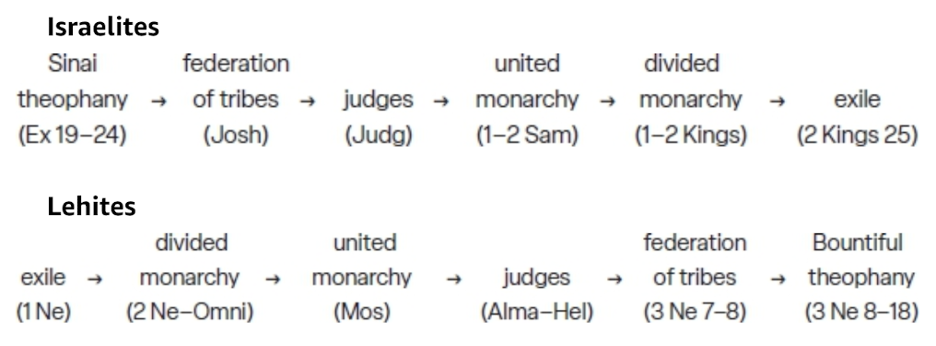
For anyone familiar with the Bible, the Nephite shift from the reign of kings to the reign of judges is a striking contrast to the Israelite story, but additional parallels are notable. The biblical period of divided monarchy, when Israel and Judah were separate kingdoms, is mirrored by the disparate lines of kings among the Nephites and the Mulekites (also led, respectively, by the tribes of Joseph and Judah). In both cases, the era of united monarchy lasts for just three kings: Saul, David, and Solomon are paralleled by Mosiah1, Benjamin, and Mosiah2. The sin cycle in Judges is reflected by the pride cycle in Helaman and 3 Nephi. And the climactic moment of the Book of Mormon, that is, Christ’s post-resurrection visit, returns the Lehite/Mulekite Israelites into God’s presence as he fulfills the law given at Sinai, thus imparting a balanced, satisfying arc to the Lord’s covenantal relationship with this branch of his chosen people. Grant Hardy, Annotated BM
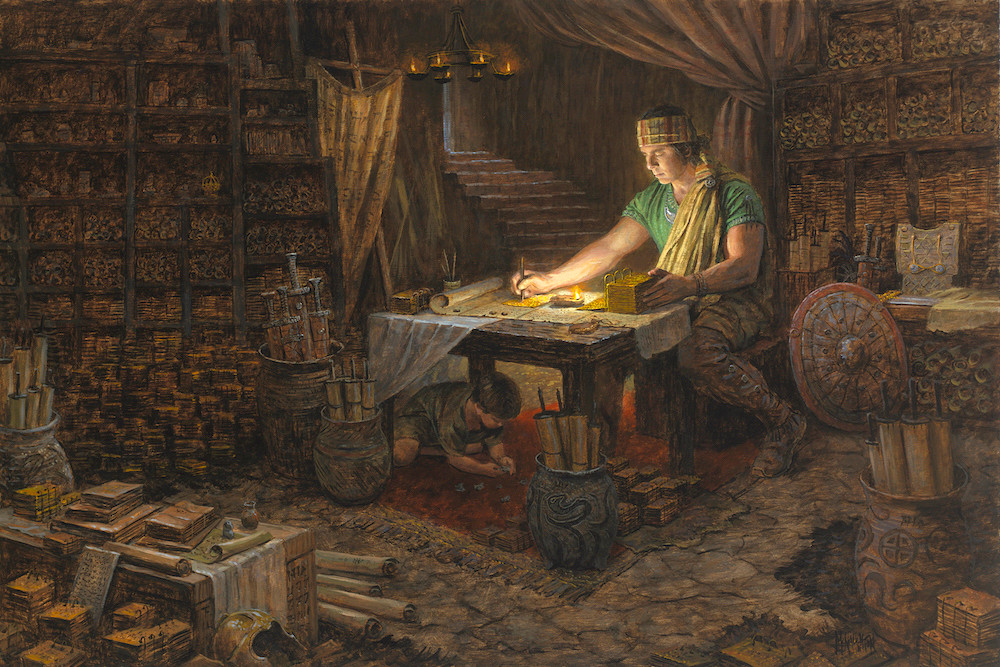
Mormon was a careful editor and historian. He must have worked from an outline because he has a clear purpose (Title Page) and consistently references events he will include in the future (eg Hel 2:12-13). He inserts multiple primary sources into his history, including memoirs (Mos 9–10), proclamations (Mos 29), sermons (Alma 5; 7; 36–42; 3 Ne 12–14; 20–22), letters (Alma 54; 56–58; 60; 61; 3 Ne 3), and more. The narrative also includes brief editorial asides such as “thus we see” comments, notes on sources, instances of foreshadowing or summary, and observations of fulfilled prophecies.
Mormon’s work constitutes the longest and most complex scriptural writing preserved. No writer of either the Old or New Testament has written so much material that focused on demonstrating a particular religious point. (Only the Deuteronomists, as conceived in the documentary hypothesis, have had as much impact on the preserved tradition.) No other writer in all of scripture has described a thousand years of history in such a way to tie that history to the will and work of God. Brant Gardner, Annotated BM
More specifically, Mormon divided his work into books and chapters, though our current chapters are different from the chapters in the 1830 edition of the BM (Orson Pratt is largely responsible for the chapters we have now). There were no verses or punctuation. Those were added by John H. Gilbert, typesetter in E. B. Grandin’s shop for the Book of Mormon.
Given that Joseph Smith said the 116 pages contained the Book of Lehi, it appears Mormon created 7 books: Lehi, Mosiah, Alma, Helaman, Nephi, Nephi, and Mormon. One question is why Mormon named the books as he did, since virtually all of the books have more than one writer. One possibility is that the change in book names is related to the shift in the ruling dynasties and the passage of the plates in and out of those dynasties. (see Brant Gardner’s analysis in Second Witness)
Mormon appears to purposely omit the Davidic covenant in his record. Scholars generally agree that the Bible contains four major covenants: (1) the Noahic (no more flood; Gen 9.1–17); the Abrahamic (land and posterity; Gen 15; 17); the Mosaic (Israel protected if they kept his commandments; Ex 19–24); and the Davidic (right to rule in perpetuity; 2 Sam 7 and Ps 89). In the BM, the Mosaic covenant is ubiquitous and the Abrahamic is referenced 8x, but the Noahic and Davidic are never mentioned. For the Davidic, this seems odd if members of the royal lineage (Mulekites) lived among the Nephites. Mormon likely wanted to downplay their attempts to restore the monarchy—we even have to piece together what’s going on because he is so cryptic about it—the ‘king-men’ for example in Alma 51 sound power-hungry, but they were likely Mulekite descendants simply seeking to restore their rightful authority as they “professed the blood of nobility” (Alma 51.21); or the regular tensions between groups of priests (Mos 23–24; Alma 13). In fact, most of the stories of dissensions related by Mormon might be ascribed to the Mulekites, some of whom may well have resented Nephite political and religious rule (as did the Lamanites, who were regularly allied with Nephite dissenters). James Faulconer gives another way of looking at Mormon’s history:
A plausible, if speculative, alternative account of Nephite history might run along these lines. When Mosiah1 and his followers encountered the people of Zarahemla, who had preserved the memory of his genealogy (Omni 1.18), the two leaders realized that Zarahemla had the divine right to rule, but Mosiah had the sacred text that documented that right, as well as the linguistic skills to access the scripture (Mos 1.1–5). On the other hand, the Nephites, who were committed to living the law of Moses (2 Ne 5.10; Jarom 1.5) lacked the Levites necessary to fully implement the law. An arrangement was made whereby the Nephites would set up a caretaker government, that is, a period of tutelage in which the illiterate Mulekites could gain the knowledge and expertise needed to claim their rightful privileges. With the additional promise of service-oriented leadership and low taxes (Mos 2.10–18), it is perhaps not surprising that “the people of Zarahemla, and of Mosiah, did unite together; and Mosiah was appointed to be their king” (Omni 1.19). After three generations, namely, the reigns of Mosiah1, Benjamin, and Mosiah2, the original agreement was no longer tenable, though the Nephites did not wish to give up power. So Mosiah abrogated the monarchy in favor of a system of judges—which turned out to be Nephite rule by another name. The chief judges were all Nephites and the position tended to be passed from father to son. Naturally, there was opposition from Mulekite elements of the population. And the sons of Mosiah, as princes dispossessed of their kingdom, went on a mission to the Lamanites, taking their literacy and the scriptures (Alma 18.36–38; 22.12–13), perhaps hoping not only to win souls but also to establish a political alliance similar to what the Nephites had with the Mulekites.
*
Other interpretations are possible, of course. Were there factions among the Mulekites? Did Benjamin marry a Mulekite woman so that Mosiah2 and his sons could claim both lineages? How common was intermarriage and what was the social status of their offspring? What was the ethnicity of the dissidents Nehor, Amlici, and their followers? Or the priests of Noah and the residents of Ammonihah? Did particular cities attract Nephite or Mulekite settlers? In any event, Mormon’s abridged history has significant gaps (even if he leaves no ambiguity about the correctness of the Nephite traditions). Perhaps he was afraid that if he provided a fuller account, it might have provoked reader sympathy for the legitimate claims of Nephite dissenters and Mulekites. To be sure, an account of the voyage of Mulek and his people to the Americas would have been a spectacular tale, especially if followed by the story of how remnants of Joseph and Judah reunited on the other side of the world after the destruction of their two kingdoms, but Mormon shows little interest in explaining any of this.
*
As readers follow the contours of Nephite history from the book of Mosiah on, it would be well to keep in mind the persona of the author-editor Mormon, who describes himself as “a pure descendant of Lehi (3 Ne 5.20), shaping the narrative for his own purposes. He is something of a tragic character, who will witness the utter collapse of Nephite society after his own preaching and military endeavors have failed. Perhaps this is why he seems so enamored of figures in Nephite history who managed to save their people in ways that he himself could not—men like Alma2, Captain Moroni, Helaman1, and Nephi2. Nevertheless, Mormon sees his writing project as a bridge between the past and the future, bringing the desires of his prophetic predecessors to fruition, and also making it possible for his latter-day readers to return to covenantal faithfulness (see 3 Ne 5 and 29–30). James Faulconer, Mosiah: A Brief Theological Introduction
Notes on The Book of Mosiah
The best candidate in Mesoamerican for Zarahemla is the Grijalva river basin where descendants of the Olmec spoke a daughter language of the original Mixe-Zoque called simply Zoque.

Archaeologically speaking, the 1st century of the Preclassic period, which the book of Mosiah is now entering, saw the development of three social trends that show up in Mosiah and have a marked impact on Book of Mormon history: (1) the rise of the Maya kings, (2) the rise of social hierarchies because of increased trade wealth (jade), displacing what scholars call a “previous egalitarianism,” and (3) the rise of the ‘cult-war,’ or wars fought not simply as political strategies but also for religious reasons. (Linda Schele and Mary Miller, The Blood of Kings)
Mosiah is the only book that Mormon edited which does not have a book header. This points to the fact that the first two chapters of Mosiah were lost along with the rest of the content on the 116 pages. Royal Skousen’s examination of the printer’s manuscript indicates that Mosiah 1 originally appeared as the third chapter. Moreover, Mosiah 1:1 reads more like a conclusion than an introduction: “And now there was no more contention in all the land of Zarahemla, among all the people who belonged to king Benjamin, so that king Benjamin had continual peace all the remainder of his days.” This suggests that the missing chapter II covered the civil war during Benjamin’s reign. Perhaps the missing chapter I contained the information about Mosiah1’s flight from the city of Nephi and installation as king in Zarahemla. This is important to note because the Book of Mosiah is no doubt named after Mosiah1 and not Mosiah2 as many supposed.
Mormon chooses to spend much of his Mosiah recap on the flashbacks to Zeniff’s story, likely because it explains the origins of the Christian church that will become a major institution for the rest of the Nephite story. It also introduces the family line that will serve as the remaining record keepers—Alma down to Ammaron.
The book of Mosiah is an especially beloved book by many LDS, primarily because of four stories: (1) King Benjamin’s sermon, (2) King Noah and Abinadi, (3) Alma the Elder’s conversion, and (4) Alma the Younger’s conversion.
The stories in Mosiah are sufficiently dramatic to catch the imagination of young children and have been repeated in many Primary and Sunday School lessons. Abinadi’s and Benjamin’s teachings on repentance carry enough theological heft to form the basis for numerous sermons and lessons by seasoned adults. James Faulconer, Mosiah: A Brief Theological Introduction
Yet the book can be a hard one to follow because it’s missing its beginning, it consists of a major flashback and two additional flashbacks, and it ends weakly, almost as footnotes to the events of Alma the younger’s conversion. The book has been divided in different ways, but the following is one I find useful:
- Mosiah 1–8 In Zarahemla
- Mosiah 9–20 To the Land of Nephi
- Mosiah 21–24 Return to Zarahamla
- Mosiah 25–29 The dissolution of the kingdom and the establishment of the church

While a theme in Mosiah could humorously be summarized as “How To Get Lost in the Wilderness,” there is in fact a more consequential theme: Deliverance, which takes two forms—physical (eg Limhi & Alma people from Lamanite bondage) and spiritual (eg Benjamin’s and Alma’s people who received a remission of their sins, Mosiah 4:3; 27:28-29). And yet there is an even greater theme: Division & Unity, and in particular, how covenants can create unity. The book of Mosiah draws our attention to governance, but it’s not about government, it’s about how to unite a people. It’s about highlighting that a good, unified society is founded on the people’s conversion rather than on the kind of government they have. Two scholars summarize this theme particularly well:
The book of Mosiah takes place shortly after the first major instance of convergence, when some of the Nephites, of the tribe of Joseph, encounter the Mulekites, of the tribe of Judah, who were also refugees from Jerusalem at the time of the Babylonian conquest. Their union in the New World under a single king, Mosiah1, could have been depicted as a partial fulfillment of the prophecies and hopes of the biblical generations riven by conquest and exile. For example, desires for a reunification of the peoples of Judah and Israel (led by the Ephraimite branch of Joseph) can be seen at Hosea 1.10–11, Isaiah 11.12–13, Jeremiah 50.4–5, and Ezekiel 37.15–28. Yet this is not the interpretation adopted by Nephite record keepers, perhaps because Mosiah, a descendant of Joseph through Manasseh, could never be a promised Davidic king, or because the unification of the two peoples was still incomplete even after two or three generations of alliance (Mos 1.10; 25.2). In the Book of Mormon, the solution to political and religious divisions is the establishment of new covenants. The Lehites brought the Mosaic covenant with them, and their possession of the Brass Plates enabled them to remember and live by its precepts (1 Ne 4.14–15; Mos 1.4–5). The first additional covenant in the Book of Mormon, God’s promise to Lehi that “inasmuch as ye shall keep my commandments ye shall prosper in the land; but inasmuch as ye will not keep my commandments ye shall be cut off from my presence” (2 Ne 1.20), can be viewed as a codicil to the Mosaic covenant (e.g., Deut 5.32–33), with application to a new promised land in the Americas. But this was not enough to keep the Nephites and Lamanites together, and it was not enough to forge the Nephites and Mulekites into a single people. To that end, King Benjamin introduces an entirely new covenant (Mosiah 1:10-12; 5:7-11)… The hope, apparently, is that individuals will no longer identify primarily as Nephites or Mulekites, with their rival ancestral traditions, but rather as “children of Christ.” Unfortunately, this does not work out as planned, because those who were children at the time do not grow up to embrace the new covenant identity (26.1–6), in contrast to Jews who generation after generation have thought of themselves as having been among those who covenanted at Sinai (see Deut 4.9–10; 5.2–3). At about the same time, however, another covenant was introduced independently in the Zeniffite colony. There Alma1, who had been one of the wicked priests of King Noah, was converted by the prophet and martyr Abinadi. He established a clandestine church in the borders of the land, with baptism as a sign of the new covenant (Mosiah 8:8-10)…By chapter 25, the two groups from Zeniff’s colony are reunited with the main body of Nephites and Mulekites. Alma is able to spread his church widely among the people, with the covenant of baptism superseding or merging with the covenant established by Benjamin. When King Mosiah2 declares an end to the monarchy, his intention is to perpetuate a similar combination of political and religious power by investing one man, Alma1’s wayward then repentant son Alma2, with the dual offices of chief judge and high priest. This overlapping authority will prove difficult to maintain, and in Alma 4 the two positions will be split, after which the Nephite church will be a unifying force for those identifying with the Nephite traditions, including Mulekites and converted Lamanites. Grant Hardy, Annotated BofM
Mosiah is a remnant of a book telling the story of a remnant of the people of Nephi, themselves a remnant of the people of Lehi, whose people were a remnant of Israel. The fragmentary character of Mosiah is the result of a number of separations: Lehi separated from those at Jerusalem to settle in a new land. Nephi separated from his older brothers to settle a new land. Mosiah1 left the land of Nephi and discovered Zarahemla (and the Mulekites), where he established a kingdom. The text of Mosiah continues this theme of separation by depicting two further fragmentations of Mosiah1’s people. The first occurs after Mosiah1’s death, when Zeniff and his followers leave Zarahemla to establish a new colony back in the land of Nephi. The second shortly follows when Zeniff’s colony, although stable for a time, divides under the rule of King Noah. Thus, one can quickly observe that Mosiah’s narrative is tightly wrapped up with central themes of separation and fragmentation. While the book of Mosiah relates a story of division and contention among various peoples, the text ends on a slightly different note. At the conclusion of the narrative, the people of Zarahemla (Nephites and Mulekites), the people of the land of Nephi under Limhi (a son of Noah), and the converts who followed Alma1 are finally united. But this unity is only temporary because apostasy almost immediately threatens to again fragment the newly united people (Mosiah 26:2–10). Though the book of Mosiah ends on a hopeful note, we can perhaps understand its theme to be the question that Benjamin and his son Mosiah2 confront: What can they do to prevent the continued fragmentation of God’s people? James Faulconer, Mosiah: A Brief Theological Introduction
1 no more contention, unfortunately we don’t have the first two chapters of Mosiah, which would have given us more insight into these contentions and how the holy men restored peace. This statement is conclusory, pointing to the fact that there is content missing. continual peace all the remainder of his days, how much longer did he live after peace was established? He does live at least three years after his speech (Mosiah 6:5). The phrase ‘continual peace’ is applied in the BM to a period as short as a single year (Alma 3:32) and to another as long as twenty-two years (Mosiah 10:5), so it may refer more to quality and depth than duration. It’s not found in the standard works outside of the Book of Mormon.
2 three sons…Mosiah, Helorum, and Helaman, he doesn’t mention his daughters, which is sad. We know little of Helorum, and nothing specific about Helaman. As trivia, it’s interesting that both the name Nephi and the name Helaman are used for three individuals in the Nephite record, tying for the most appearances of the same name for different people :). taught in the language of his fathers, likely Hebrew and Egyptian (see v4 note). Giving our children tools to be lifelong learners is a gift. More specifically here, this would allow his sons to read and write scripture, to keep the records. Other ‘teaching children’ scrips: Moses 5:12; 6:5-6, 58-62; D&C 68:25; 93:44-49. men of understanding…know the prophecies, education is part of good parenting, secular and spiritual. Literacy then would have been unusual. mouths of their fathers, I would think Mosiah is speaking of actual ancestors, so largely the prophecies on the large plates and not the small one. It makes me want to know more about what’s on them.
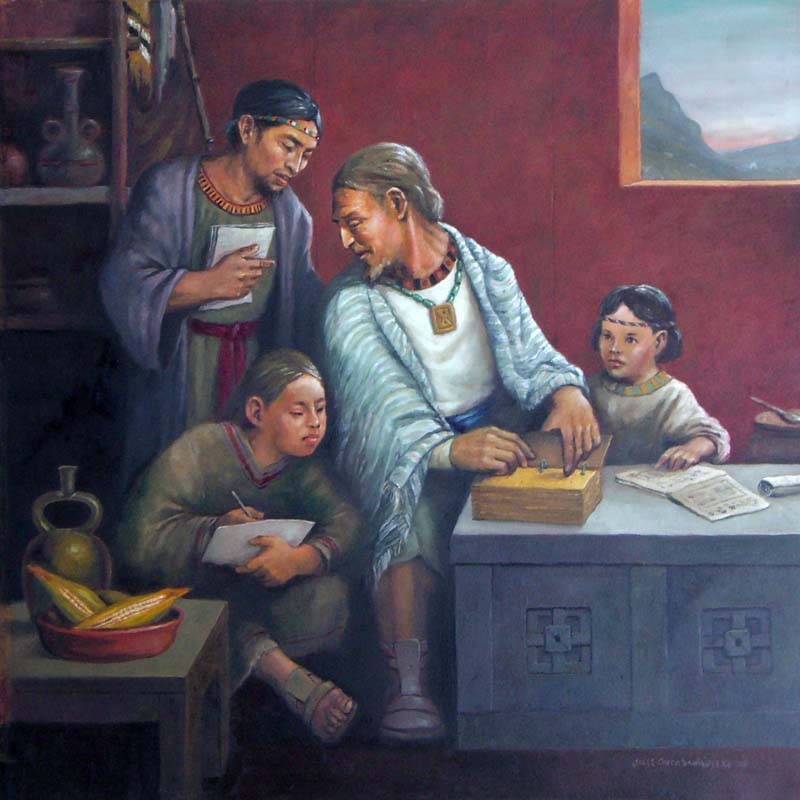
3 taught them concerning the records…plates of brass, right, he’s referring here to the brass plates. saying, this is the first quote we get from Mormon. Importantly, this recounting is mainly to set-up his discourse in the next chapter.
Mormon’s contexting for this embedded discourse is a quick sketch of the necessary historical background to explain the discourse, but his purpose is to preserve the discourse, not to recount history. That we may extract historical/anthropological data from his introduction is felicitous, but Mormon was not consciously attempting to communicate these items of information. Indeed, virtually all of Mormon’s choices are governed by spiritual rather than historical criteria, as we would understand these terms. Brant Gardner, Second Witness
my sons, I would that ye should remember, he says this exact phrase here as well as in v6 and v7. ‘remember’ with its variants is used over 220x in the BM. It’s a major theme. were it not for these plates…we would have suffered in ignorance, this was something he and his father learned when meeting the people of Zarahemla (Omni 1:17). But it was also something the family had learned through the generations from what happened to their brethren the Lamanites without scripture (v5).
4 it were not possible that…Lehi could have remembered all these things to have taught them, v5 also. Mormon is echoing the reason the Lord commanded Lehi’s sons to return to Jerusalem for the plates (1 Ne 3:19), so he must have recounted Nephi’s story with Laban and the plates in his record (now lost). He’s also about to mention the sword of Laban (v16) without giving an introduction to it, so he must have already done that. having been taught the language of the Egyptians, he could read…and teach them to their children, 2 Ne 25:26. It’s always about passing on the word of God to one’s children. A few points about language. Language is not script. There is some reason to believe that Nephi wrote in the Hebrew language but with Egyptian script (as he said in 1 Ne 1:2, “I make a record in the language of my father, which consists of the learning of the Jews and the language of the Egyptians,” see notes for that verse). The Brass Plates, however, may have been both Egyptian language and script (it’s the record of the posterity of Joseph of Egypt after all). Hebrew language written in a reformed Egyptian script is actually attested:
The earliest known example of mixing a Semitic language with modified Egyptian hieroglyphic characters is the Byblos Syllabic inscriptions (eighteenth century B.C.), from the city of Byblos on the Phoenician coast. This script is described as a “syllabary [that] is clearly inspired by the Egyptian hieroglyphic system, and in fact is the most important link known between the hieroglyphs and the Canaanite alphabet.” Interestingly enough, most Byblos Syllabic texts were written on copper plates. Thus, it would not be unreasonable to describe the Byblos Syllabic texts as a Semitic language written on metal plates in “reformed Egyptian characters,” which is precisely what the Book of Mormon describes. William Hamblin, quoted in Brant Gardner, Second Witness
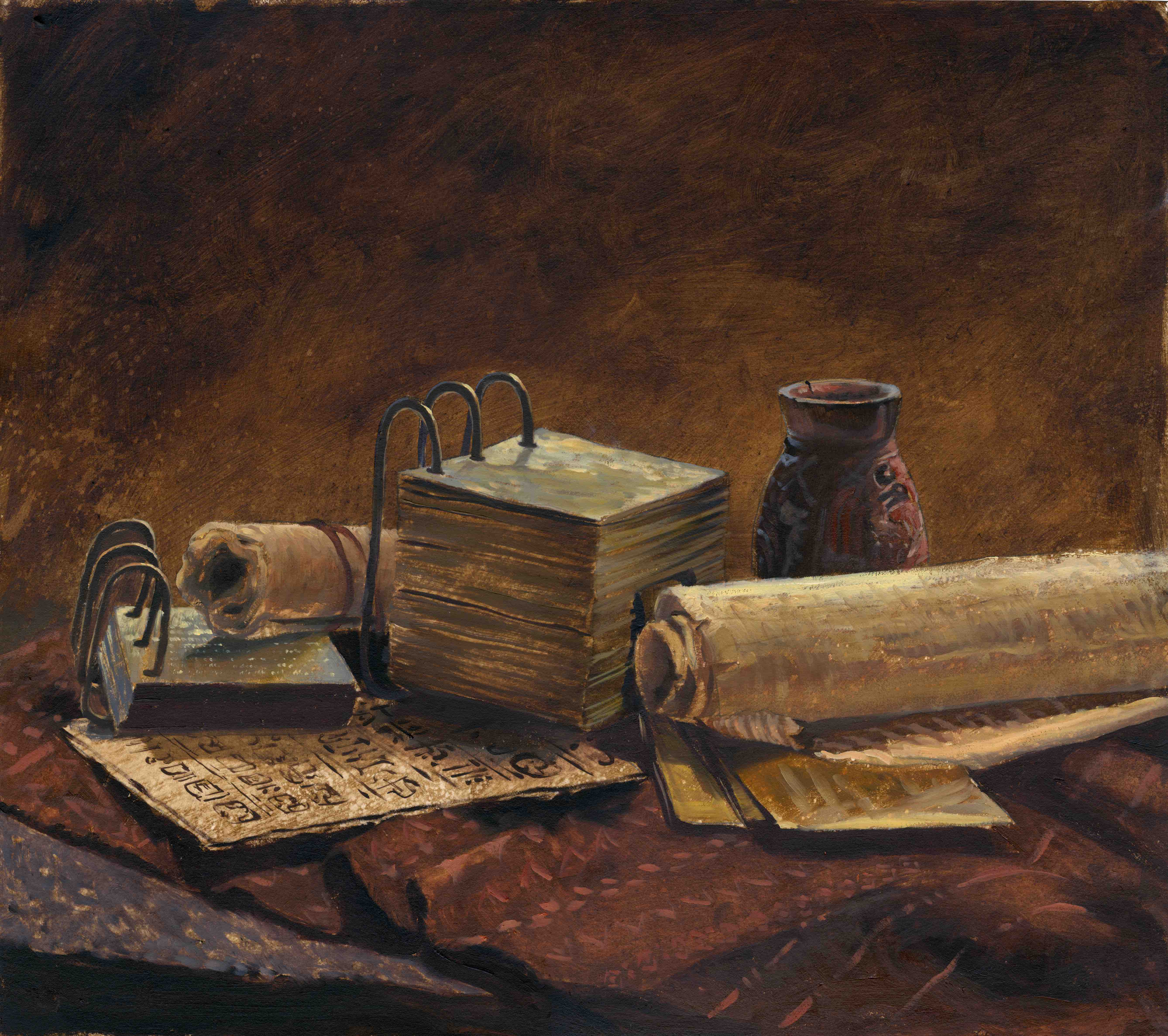
5 kept…preserved, even the short entries by Omni & sons. The ancient practice of inscribing laws on plates is also well attested (see Evidence Central, Plates & Law). understand of his mysteries, Dt 6:7. In the scriptures a mystery is something that comes by revelation. The mysteries, i.e. revelations, are found in the Nephite records. have his commandments always before our eyes, This also fulfills the covenant in Deut 6:8 (also 17:18-20) about having the law as “frontlets between thine eyes,” ie phylacteries. we should have been like unto our brethren, the Lamanites, who know nothing…or do not believe them, Alma makes the same point in Alma 37:8. It wasn’t a matter of literacy but of not having the sacred texts. What king Benjamin fails to explain is why. Oral traditions can pass down an immense amount of history, so sacred texts don’t seem to be absolutely necessary.
Almost certainly it was cultural change more than a lack of a particular written record that caused the divergence between the two. The best explanation of the wide divergence, as I see it, was that the Lamanites adopted native culture so completely…For [the Nephite’s] part, they mightily resisted that native influence, returning repeatedly to their sacred texts to provide sanction for such efforts. Brant Gardner, Second Witness
When Benjamin tells the origin story of the Nephites and describes the importance of the plates, he passes down the idea of separation between the Nephites and Lamanites. The value that he gives the plates is based on a comparison to the Lamanites: we need the plates so that we are not like them. This is a less effective way of teaching the worth of knowledge…Benjamin’s history also ignores the active role that his ancestors played in the Lamanites not having the plates. Nephi took the plates with him when he departed into the wilderness. That was a justifiable action given his situation. But to criticize the Lamanites for not having the plates when your own folk have some responsibility for the current status ignores the historical account. Fatimeh & Salleh, The BofM For The Least of These
when they are taught them, were these efforts still going on then? It looks like there were unrecorded missionary forays. They could also simply have been failed diplomatic outreach. because of the traditions of their fathers, 18x in BM. Benjamin rules over a populace made up of a minority of Nephites and a majority of Mulekites (25:2). While he contrasts Nephites and Lamanites here, differences with the Mulekites may have been even more significant.
6 these sayings are true…these records are true, a father’s testimony. Here he is speaking of the brass plates. also the plates of Nephi…are true, likely referring to the large plates. Equating their truth with the truth of the brass plates suggests that they have acquired scriptural status. we can know of their surety because we have them before our eyes, their existence and provenance prove their authenticity.
7 search them diligently that ye may profit, the scriptures actually never command us to read scripture but use other words like search, meditate upon, feast upon, hold fast to, treasure up, rely upon, live by, delight in, etc. keep the commandments, etc. according to the promises of prosperity. The purpose of scripture is not just that we learn something, but that we do something.
8 many more things… not written in this book, Mormon’s quote from Benjamin’s words is now over, though they are recorded elsewhere in Benjamin’s record.
9 teaching his sons, and daughters, we hope. waxed old, saw that he must soon go the way of all the earth, phrase used in Josh 23:14; 1 Kgs 2:1-2. expedient, see Mos 4:27; 5:3; 6:1. Webster’s 1828 defines ‘expedient’ as ‘tending to promote the object proposed; fit or suitable for the purpose; proper under the circumstances’ rather than the modern meaning of a practical shortcut. confer the kingdom upon one of his sons, kingdoms are never “conferred” in the Bible, though there are ten such instances in the BM.
10 Mosiah2, presumably the oldest. my son, I would, it is likely that writing in the first person is a literary device. Even speeches would have been polished in a written text. proclamation, another proclamation—religious freedom—will be made later by King Anti-Nephi-Lehi in Alma 23. people of Zarahemla, and the people of Mosiah1, so the two groups, though ‘united’ (Omni 1:19), are still separate, even after approx 60 years since the arrival of the Nephites in Zarahemla. In what way are they separate? In any event, Benjamin regards all his subjects as entrusted to him by God, and he apparently hopes to unify them more fully by giving them a new name that will replace former designations and allegiances. who dwell in the land, suggests that the people of Mosiah are still regarded as resident aliens or a minority population. gather together, c/w others who have brought their posterity together to teach and bless them prior to their deaths, namely, Adam (D&C 107:53), Israel (Gen 49), Joseph (JST Gen 50:24-38), and Moses (Dt 33). I shall proclaim…out of mine own mouth, better this than him dying without an appointment, and the consequent contention that may arise among the sons and people (this happens later in both Alma and Helaman). The clear pronouncement in a public forum would decrease potential disagreements about succession—at least to the extent that Benjamin’s kingship is recognized as valid. thou art a king and a ruler, any difference between the two?
While royalty throughout time has claimed divine rights, it’s worth questioning whether this was true or whether this structure simply smoothed the transition of power. The Book of Mormon itself suggests an argument against a divine sanction of birthright to political office by Mosiah’s later decision to replace the monarchy with a system of judges (Alma 29). Fatimeh & Salleh, The BofM For The Least of These
this people whom the Lord our God hath given us, interesting paradigm that God gave the people to Benjamin and his family. Stewardship, though some would say colonialism.

11 give this people a name, Christ, or Christians. It will also come with a covenant (Mosiah 5:5). And why give them a name? In order to unite them. They are still two separate groups who identify as the “people of Mosiah” and the “people of Zarahemla,” but from this time forward, he would have them identify as the “people [or the children] of Christ!”
Benjamin is making a bold political move designed to preserve the internal peace he has created, perpetuating it by restructuring the political world within the city of Zarahemla. While kin divisions will certainly remain, Benjamin intends to erase political divisions and unify the people… In the context of Words of Mormon 1:16–18, Benjamin sees this political move as specifically related to the resolution of the internal religious conflicts that Mormon summarized. Brant Gardner, Second Witness
Not only was the new name, found in Mosiah 3:8, uniquely and distinctively given for these particular people and for this specific occasion, but, even more importantly, this designation was given to the people, not just to the new king. In traditional Israelite coronations, only the king entered into the covenant with God and thereby became his son (see Psalm 2:7). In Benjamin’s kingdom, however, every person was allowed to enter into a covenant in connection with Mosiah’s coronation (see Mosiah 5:1–5), and thereby they all became God’s ‘sons, and his daughters.’” John Welch, King Benjamin’s Speech
distinguished above all the people…brought out of Jerusalem, why distinguished among that group? The only ones they know of who have come out of Jerusalem are the Lamanites, Mulekites and Nephites. If the Nephites and Mulekites truly unite, then it’s the Lamanites whom they are ‘above’ or at least distinguished from. This may be another way of uniting them—in contrast to or defense against the ‘other’ Lamanite group. I do because they have been a diligent people…keeping the commandments, he must feel that as a people they are ready to make a covenant (5:5). I suppose he wouldn’t want them making a covenant before they were ready, as there would be consequences to breaking it.
12 name, 5:7 “the children of Christ” or just “Christ” 5:8. never blotted out except through transgression, the idea of blotted out refers to the scriptural metaphor of salvation being described as having one’s name written in the book of life. As there were no erasers back then, a name would have to be literally blotted out (a Tyndale metaphor, there are other translations). In the Bible, the names of individuals can be blotted out of God’s book (Ex 32:32–33; Ps 69:28; Rev 3:5), and God can blot out transgressions as he forgives sin (Ps 51:1, 9; Isa 43:25; 44:22; Acts 3:19). Here, however, it is the divine name that is blotted out of the heart of a person who transgresses the law, Mos 5:11.
13 highly favored, blessed. if…this people should fall into transgression, the Lord will deliver them up…no more preserve them…as he has hitherto, example in Hel 4:24-26 and elsewhere in the BM, in particular at the end. weak like unto their brethren, brethren meaning the Nephites who stayed behind in the Land of Nephi when Mosiah left? Omni 1:12-13. matchless and marvelous power, great phrase, seems typical of Benjamin, see ch 4.
14 if he had not extended his arm in the preservation of our fathers, both groups of fathers—Mulekite and Nephite. they must have fallen into the hands of the Lamanites and become victims of their hatred, salvation history, or seeing God’s hand in the affairs of men. It’s a prophetic gift—both Benjamin and Mormon have it. Do we?
15 gave him charge concerning all the affairs of the kingdom, The book of Mosiah is framed here at the beginning by King Benjamin giving his son Mosiah ‘charge concerning all the affairs of the kingdom,’ and then at the end when Alma1 similarly gives his son Alma2 ‘charge concerning all the affairs of the church,’ Mos 29:42. It always fascinates me how the prophets so deliberately and poetically craft scripture!
16 gave charge concerning the records, sword of Laban, ball or director (Liahona), the holy relics. The book of Mosiah ends with a similar event when Alma1 giving the relics to his son Alma2 (29:42). These sacred relics serve as physical reminders of the covenant between God and the people, and tangible witnesses of God’s fulfillment of his promise.
prepared by the hand of the Lord that thereby they might be led…according to the heed and diligence, etc. dealt with this in 1 Ne 16-18. Did Mosiah1 use the Liahona to guide his people through the wilderness to Zarahemla, or does the Liahona now function only as a sacred relic? As to ‘according to the heed,’ there are degrees of diligence and thus degrees of guidance.
17 as they were unfaithful they did not prosper nor progress, more info about what happened in the wilderness. Large plates must have had much more information about this event. smitten…to stir them up in remembrance, as was prophesied by the Lord, 1 Ne 2:24.
18 Mosiah went and did, Mosiah typifies Christ. go up to the temple to hear the words, so we go to the temple to hear Father’s words. This is the first mention of a temple in Zarahemla, but there is no indication as to whether or not it predates the Nephites’ arrival.
Conclusion
There was no chapter ending here in the 1830 edition. Mormon’s chapter didn’t end until our current chapter 3.
The Book of Mormon is so incredibly rich. So many inspired lessons and applications can be harvested from its pages. I thought it fit to conclude my Mosiah 1 notes with this insight:
The narratives in the book of Mosiah might even be interpreted as cautionary tales about the dangers of colonialism, whether that comes from displacing local populations to form separate settlements, as Zeniff’s colony did before they themselves were in turn exploited, or when a small group of outsiders, like Mosiah1’s people, use claims of superior religion and culture to justify taking over a larger population (see 25.1) leading to resentment and conflict, as will happen in the book of Alma. Grant Hardy, Annotated BM

 Holy Envy