
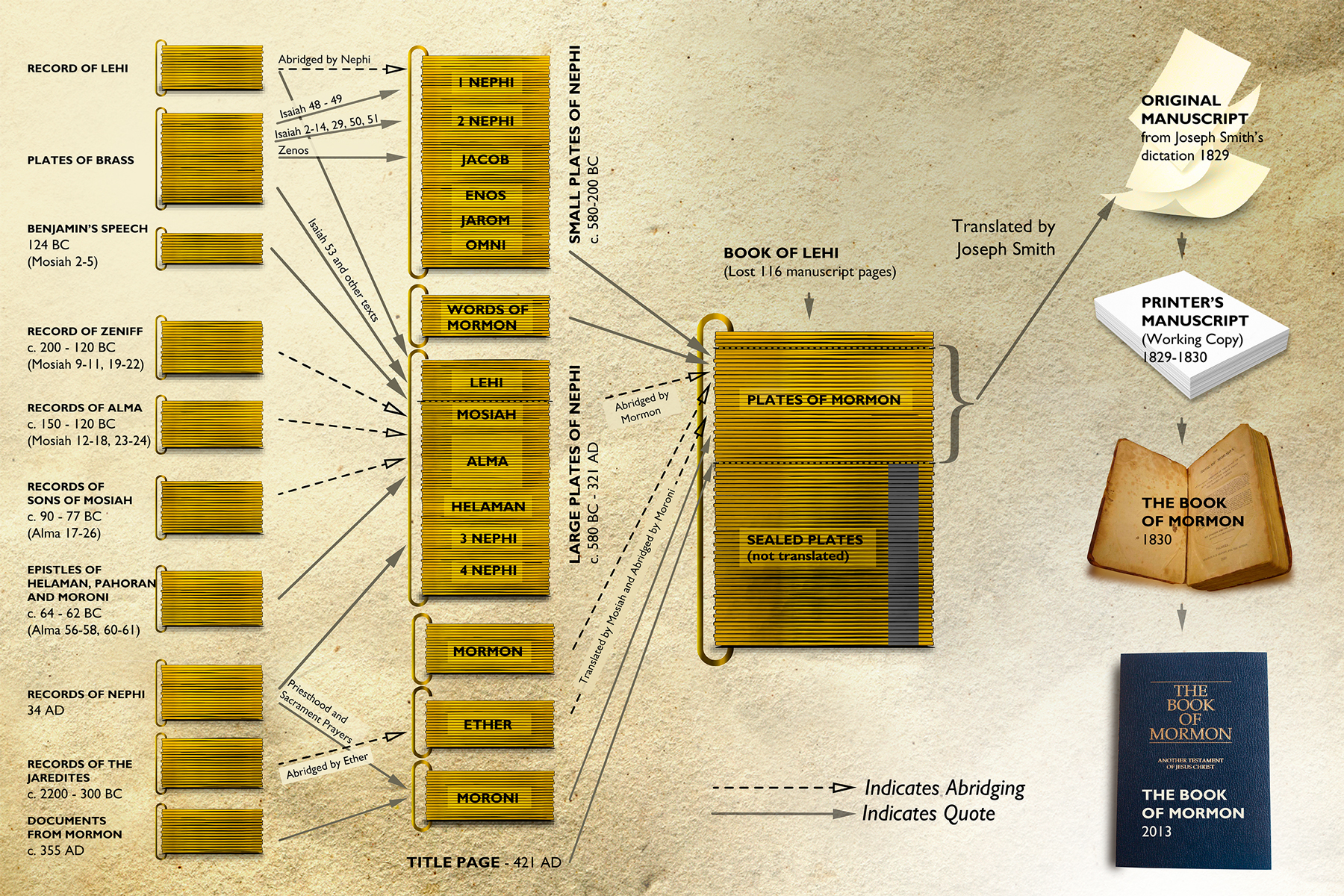
WoM is not a named book in Mormon’s work. It appears to be both an introduction to the small plates (1-11) as well as a transition between the small plates and king Benjamin’s reign (12-18). Curiously, Oliver Cowdery originally had this ‘book’ as Omni II and our first book of Mosiah as Mosiah 3. It’s also unclear where these words were written—on the small plates themselves? Amaleki said those plates were full, but perhaps there was just enough room for Mormon’s inscription. Or were they written separately somewhere? The last two decades of research as part of the Joseph Smith Papers Project helps us out here, and the following is our best guess at what happened:
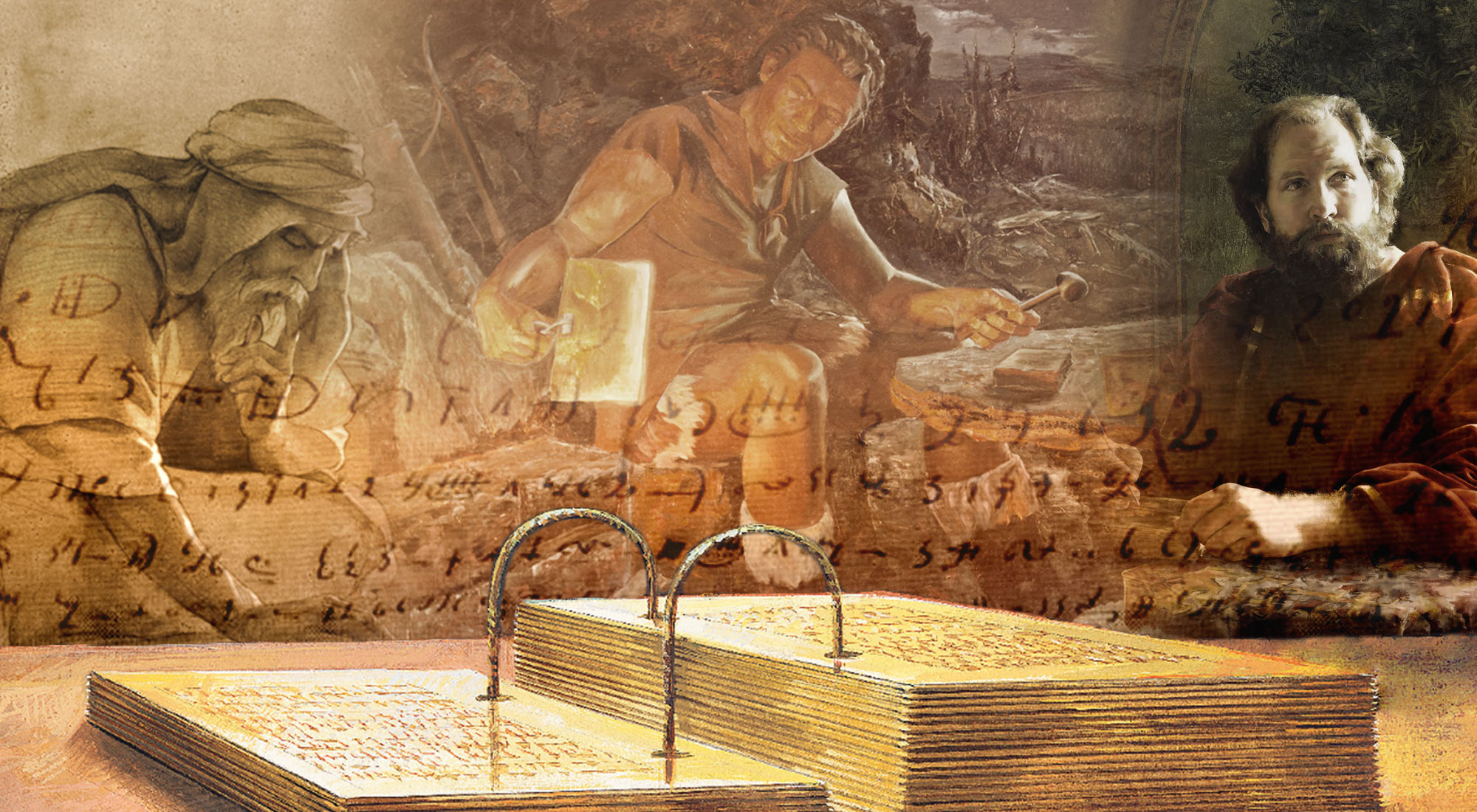
In summary, the first 116 translated pages of Mormon’s abridgement, lost by Martin Harris, included not only the history of Lehi and his family down to the time of Amaleki who delivers the plates to Mosiah, but also the first two chapters of Mosiah! Notably, our current Mosiah 1 was actually Mosiah 3 on the printer’s manuscript (see image below). This makes sense because our current Mosiah 1 begins at the end of Benjamin’s reign. Moreover, a few translated words were retained by Joseph when Martin went off with the 116 pages—a separate sheet of paper he didn’t take. The Lord referred to this when instructing Joseph about how to resume the translation, “Therefore, you shall translate the engravings which are on the plates of Nephi, down even till you come to the reign of king Benjamin, or until you come to that which you have translated, which you have retained” (D&C 10:41). It appears that those ‘retained’ words were vs12-18 from Words of Mormon, which were likely the last verses of the original Mosiah 2, but instead were appended to the Words of Mormon; and Mosiah 3 became Mosiah 1 (see Jack Welch BM Notes).

Verses 1-11, however, are clearly introductory. They are a separate text Mormon wrote as a summary of the small plates, an introduction called a ‘subscriptio’ commonly put at the end of a work in the ancient Near East (see KnowWhy).
After a simple reading of the eighteen verses that comprise the text of Words of Mormon, one notices that the first eleven verses (1-11) are written using only first-person pronouns. There are twenty-two uses of the pronoun “I,” another twenty-two uses of the pronoun “we,” and one use of the pronoun “us” in these verses. They contain no third-person pronouns. Then, in the remaining verses (12–18) only third-person pronouns are used; no first-person pronouns are found in the latter half of the book. There is a significant shift in the narrative half-way through Words of Mormon. It appears that something worthy of attention is happening at the narrative mid-point of Words of Mormon. Royal Skousen, who has done by far the most extensive work on the manuscripts and texts of the Book of Mormon, thinks that the prophet Mormon personally wrote (not abridged) Words of Mormon 1:1-11 as his final farewell address. Jack Welch, BM Notes
So,
- v1-11 Mormon’s introduction and summary of the small plates.
- v12-18 Verses from Mormon’s abridgement preceding Mosiah 1:1, not lost with the 116 pages.
385 AD
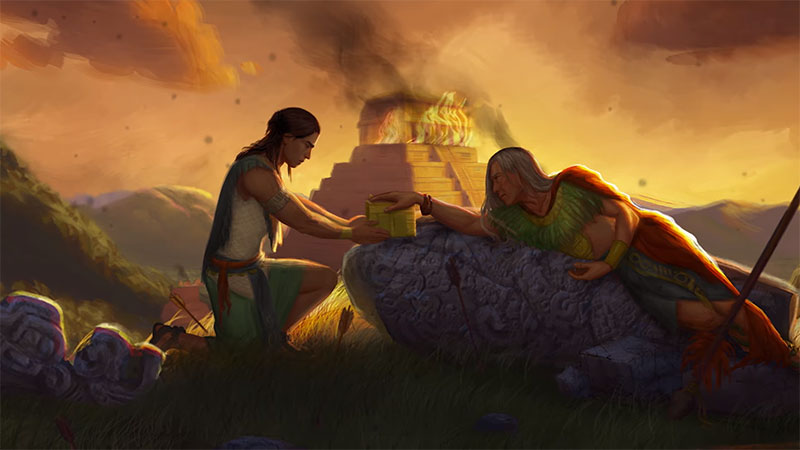
1 I, Mormon, he’ll say this 3x in the chapter (v1, 9, 11). Of course, he would have already introduced himself at the beginning of his book (contained in the lost 116 pages). In any event, we’re now catapulted 500 years forward to Mormon, 385 AD. about to deliver up the record, before it’s too late. While most of the record was likley written already (during the time he refused to lead the Nephites, Morm 3-5), he writes these verses after most of the work is done. into the hands of my son Moroni, why now? Probably because it’s post Morm 6, and he knows he will be killed soon. I have witnessed, Mormon and his son Moroni exemplify the classic signs of being “survivor-witnesses.” A post-WWII study on holocaust victims revealed that there are patterns of behavior exhibited by those who have suffered terrible human atrocities, and virtually all of the ten characteristics of the ‘survivor-witness’ typology are present in the words and deeds of Mormon and Moroni, reflecting a deep authenticity in the record (see BM Survivor Witnesses). almost all the destruction of my people the Nephites, some would have allied with the Lamanites, others escaped; but as a people, they are gone.
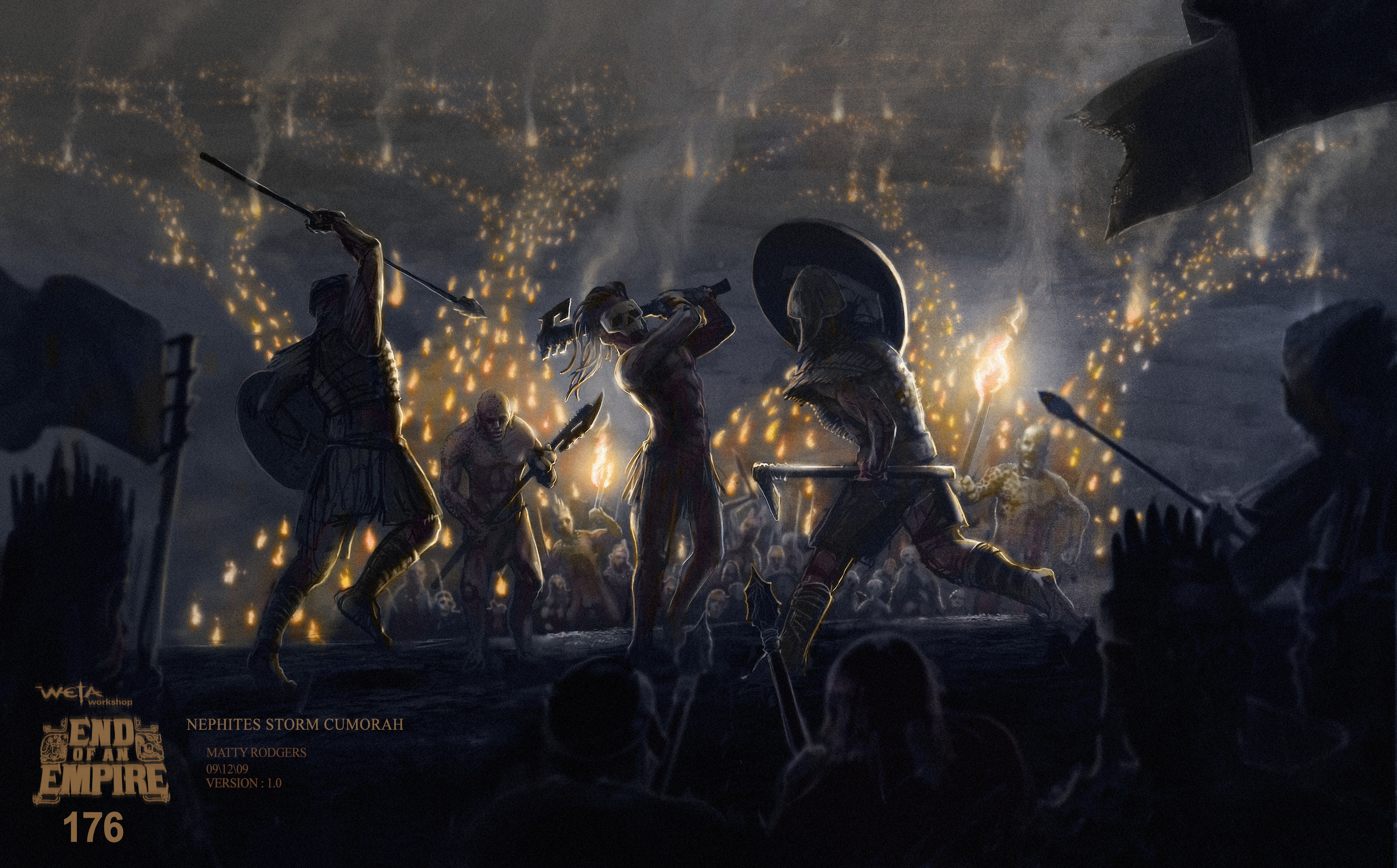
2 many hundreds of years after Christ, 385. he will witness the entire destruction, see witness in v1. may he survive them (Nephites)…that he may write concerning them (Nephites)…that it may profit them (Lamanites), just to clarify. At the end, Mormon thinks of his son, Moroni, praying for his survival.
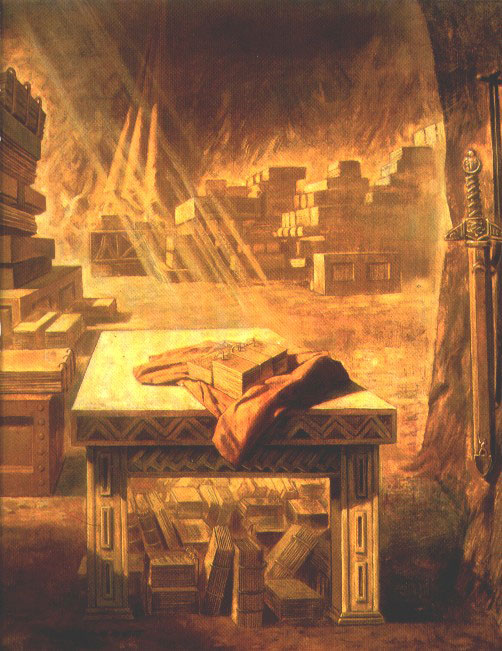
3 the plates of Nephi, the large plates, though that name never appears in the BM. It seems that this was the name of the entire set of records, though individual books had been named for specific dynasties, a designation system that Mormon retains. We’ll see later how many other records are referred to that must have been part of the ‘large’ plates of Nephi, i.e. the totality of records handed down (see Morm 2:17-18; 6:6). down to the reign of this king Benjamin, this is important because it means Mormon decided not only to include these small plates, but conclude his record with them, even before he had written the rest of his book! They obviously had an enormous impact on him. I searched among the records which had been delivered into my hands, by Amaron at the cave of records. There were obviously many, and they were not in any kind of order it seems, because he was searching and found a set he didn’t know existed. Had he read elsewhere in some of the large plates of Nephi about Mosiah receiving the small plates, and then went searching for them? Making sense of disordered plates gives us new appreciation for what Mormon had to do, and yet they may not have always been unordered. In 375 AD, Mormon had to remove the plates from the Hill Shim as they were about to be driven from the land (Morm 4:23). The haste of the removal may explain why the archive was not well-ordered as Mormon was writing.
I found these plates, small plates. Must have been an amazing find! As one author put it, “It was perhaps the equivalent of finding a second book of Mark that covered the events of Jesus’s life from a different perspective, offering new information and new contexts. Of course Mormon was impressed!” (Brant Gardner, BM Notes) small account of the prophets, I like this name for the small plates even better—the Small Account of the Prophets. Jacob is the one who calls them the “small plates” (Jacob 1:1; also Jarom 1:2, 14). from Jacob…and also many of the words of Nephi, why does he say Jacob first? Perhaps because other than Nephi, the record is Jacob’s lineage history.
4 pleasing me, interesting that he has no trouble reading them, it seems, even though the ‘Egyptian’ is now ‘reformed Egyptian’ (Morm 9:32). He was obviously a well-trained Nephite scribe. because of the prophecies of Christ, which had been fulfilled—the focus seems to be on Christ’s coming in 3 Ne 11. The idea is that Mormon’s desire to demonstrate the fulfillment of prophecies is better served by reproducing primary sources in full rather than providing paraphrased prophecies that may have been reshaped after the fact. prophecies… down to this day… and as many as go beyond this day, Mormon is confident that since they’ve been fulfilled to this point, the rest will also be fulfilled. That last ‘and’ may be better read as ‘therefore.’
5 I chose these things to finish my record upon them, some believe he may have written these verses (1-11) on the small plates themselves, even though Amaleki says they were essentially filled up. But ‘upon’ could also just mean ‘with,’ i.e. they’ll be tacked on at the end. remainder of my record I shall take from the plates of Nephi, since Mormon is about to give the plates to his son Moroni (v1), he can’t mean that he has yet to abridge the Nephite history; but he could mean he has yet to write some of his own history (Mormon 1-7). I cannot write the hundredth part, this is important to know because God’s work was bigger than just the one narrative we get from Mormon. What is here is not everything.
We have to know that any scriptural text offers a small sliver of the total, and as such, it comes from a certain angle, usually a singular perspective of the events that happened. We should keep in mind that there were other voices there and other things happening; there are other ways to look at this narrative and other interpretations of its meaning…We have to trust that the Spirit led Mormon to choose wisely. But it is also self-evident that he privileged some voices—particularly the voices of men—over others. What Mormon decided was important to him may leave out words that would have been important to people today. We can still acknowledge that these words were included because Mormon felt them move God into his life. We can appreciate the work Mormon did while also holding space for those voices who were left out. Fatimeh & Salleh, The BofM For The Least of These
6 which contain these prophecyings and revelations, great description of the small plates. put them with the remainder of my record, at the end. Also, this would spare him an incredible amount of work reading, studying, summarizing, and then engraving on his own gold plates; and no doubt, given the warfare and genocide, his time is almost out (v1).
The most logical interpretation is that Mormon read though the small plates of Nephi, then set them aside and continued the narration from Benjamin to 4 Nephi. When he was almost finished, the Lord reminded him of these small plates before he gave the plates to Moroni and that he should include them with his abridged record “for a wise purpose” (v7)… I suspect that he made the addition after finishing 4 Nephi but prior to writing his eponymous book. Once embarked on the process of abridging, there was no reason to stop to consider adding the small plates until that abridgment had been completed. Since Moroni completes his father’s book (Morm 8:1) it would not appear that Mormon had time to consider the addition and write Words of Mormon at that time. Brant Gardner, Second Witness
for they are choice unto me…unto my brethren, again as above, it would have been like finding a lost book of one of the apostles of Jesus, written by his own hand.

7 I do this for a wise purpose, because of the lost 116 pages. Nephi was also inspired to create them in the first place (1 Ne 9:5). See D&C 10:38-45 for the Lord’s explanation. for thus it whispereth me, he was moved by the spirit to do it, apart from the fact that he thought they were extraordinary. the Lord knoweth all things, we speak of the Lord’s foresight to prepare a second record (small plates) to make up for the lost 116 pages, but there may have been a second purpose other than just replacement. After Joseph received the plates back from the angel Moroni (they’d been taken from him for a time, D&C 10), he and Oliver continued translating with the book of Mosiah. The small plates, which were tacked on at the end of Mormon’s work, were translated last. This order of translation shows fascinating evidence of Joseph’s inspiration because in the rest of the Book of Mormon, authors consistently refer back, and even quote, the small plates which hadn’t yet been translated! (see KnowWhy).
he worketh in me to do his will, can we say this about ourselves? Why or why not?
What can we do so that the Lord can work in us to do His will?
8 my prayer…concerns my brethren, the Lamanites. once again come to the knowledge of God… redemption of Christ, see title page of the BofM. once again be a delightsome people, Nephi is the one who uses this phrase, but in conjunction with “fair” and “white” (2 Ne 5:21-25). Mormon, however, isolates delightsome, perhaps to separate it from the other two, and give the message that a people can be white and not delightsome, or black and delightsome.
It is possible that Mormon’s ability to deliberately separate these concepts is part of the legacy of Alma, Helaman, and 3 Nephi. Nephi’s descendants will do some important work in unpacking Nephi’s prejudice, and the time of unity among the people following Christ’s appearance will alleviate some of that hatred. Mormon is therefore the beneficiary of the healing work of his ancestors. Fatimeh & Salleh, The BofM For The Least of These
9 finish out my record, his already-abridged text, likely Mormon 1-7, not that he would begin Benjamin’s story. plates of Nephi, large plates. according to the knowledge and understanding God has given me, though inspired, it’s his record. He takes responsibility for it. It reflects his character, experience, and perspective. See v5 note above
10 he put them with the other plates, now all are joined together in the royal collection. The other plates would be the plates of Nephi and any other records handed down by the kings during the previous 450 years. It appears the term Plates of Nephi refers to all of them.
11 handed down… from generation to generation… into my hands, provenance proves authenticity. It’s a high priority for the prophets, as we saw in the book of Omni. pray… that they may be preserved, as Enos and his fathers had prayed (Enos 1:13); but he is specifically talking about the small plates here, so he doesn’t seem to be praying for their preservation so much as he is praying that they will be a part of the final translation that goes out to the world. Interesting, then, that had Martin Harris not lost the 116 pages, Joseph and Oliver may have decided not to include this small plates account. Just a thought. there are great things upon them, the small plates. out of which my people shall be judged, Nephi taught this (2 Ne 25:21-22). The point here is that if they will judged by these words, Mormon wants them to have the words so they can be prepared. great and last day, and so his introduction concluded. These words may have been the last one’s Mormon inscribed (though Morm 7 is also a good candidate).
12 king Benjamin… had contentions, possibly because when his father Mosiah died, Mulekite descendants may have vied for the throne, so they may have been political contentions, but they were also certainly religious (see v15-16). v12-18, as noted above, were likely part of the previous chapter of Mosiah (formerly Mosiah 2), providing context and a Segway directly into Mosiah 1:1 (formerly 3:1), which begins, “And now there was no more contention in all the land of Zarahemla.”
13 Lamanites came down, from the highlands of Guatemala, presumably. As always, they would have been more numerous than the Nephites. This is mostly likely the war Amaleki refers to in Omni 1:24. to battle, what was ancient warfare like? We’ll discuss later. Ironically, their internal contentions ceased so they could meet the greater external threat. he did stand…he did fight, king Benjamin himself, in defense of his people. with the sword of Laban, iconic. In the ancient near east, swords were seen as symbols of authority, kingship, or divine favor (read KnowWhy comparing sword of Laban to the sword of Goliath). It always stays with the plates as a reminder that blood was spilt for them. Benjamin is the only other person other than Nephi who is mentioned as having used the sword in battle (Jacob 1:10). There may have been no other technology like it, no other sword quite like it (no steel in ancient Mesoamerica); so to see the king with the steel sword leading the armies on the battlefield must have been something. Some see the sword here playing only a ceremonial function and not a military one—a visual symbol and reminder of the Lord’s watchcare.

14 in the strength of the Lord they did contend, 8x in the BM, several in the Bible. If truly just in defense only, this rings true to me, especially knowing Helaman and Captain Moroni’s later defensive efforts. slain many thousands, again, Lamanites were more numerous. The sheer numbers though, the tragedy of death in war on either side, is unfortunately something we get inured to as we read the Book of Mormon. We ought to resist that. driven them out of all the lands of their inheritance, likely Zarahemla and environs, i.e. Mulekite territory; although some Nephites considered the land of Nephi still part of their inheritance, hence they tried to return (Omni 1:27).
15 false Christs, those claiming falsely to be the Messiah (the term is used in Mt 24:24; Mk 13:22, both of which also include “false prophets”). False Christs is different than anti-Christs. Some suggest this is a reference to the common Mesoamerican religious practice of impersonating deities—representing a god by donning its mask. Another possibility is that given the recent union of Nephites and Mulekites, there may have been people from the latter group claiming rights of kingship, since the title messiah was often used in the OT to refer to human kings, particularly in the line of David.
The word “Christ” is equivalent to the word “Messiah” in Hebrew, which means “anointed one.” In other words, “there had been many false [Messiahs]” in the land. It is of interest to note that the two names “Mosiah” and “Messiah” would have been very similar in Hebrew. “Mosiah” is also the way in which the word for “Redeemer” is vocalized in Hebrew. It may have been that King Benjamin had to deal with people claiming that it was their job not just to be a religious leader (a priest or anointed one), but to be a political leader of some kind. Jack Welch, BM Notes
mouths had been shut, huh? It’s probably just a manner of speaking; i.e. they were prosecuted or imprisoned. punished according to their crimes, presumably not simply for their beliefs; but if some were indeed challenging the throne, their crimes could have been related to sedition.
16 false prophets, preachers, teachers…punished according to their crimse, what would have been the crimes of these? much contention and dissensions away unto the Lamanites, it’s apparent that these internal contentions were religious, which may overlap with Nephite/Mulekite tensions. Likely the defections were simply over to non-Nephites and not the ‘Lamanites’ from the recent battle. Presumably, they retreated north toward the old Jaredite (Olmec) homeland, where they had a similar linguistic, cultural, and religious heritage. with the assistance of the holy prophets, Enos had said hundreds of years earlier that there were “many prophets among us” (Enos 1:22). Who were these prophets? Are they the same as the “holy men” mentioned in the next verse?
17 king Benjamin was a holy man, ‘holy prophets’, ‘holy man’, and ‘holy men.’ Why does Mormon use this descriptor? he did reign…in righteousness, as we’ll see in his sermon. many holy men, Benjamin is only able to maintain religious standards with the help of other ‘holy men,’ and even with them they had to give their all. What would it have been like for Mormon, who was utterly alone in his efforts, to read about how king Benjamin was able to call on prophets and holy men to stem the tide of contention and bring peace to his people? speak…with power and authority, as Jesus taught “as one having authority.” I have always understood this as pointing to integrity—teachers actually living what they preach, knowing from experience, not asking anyone to do anything they wouldn’t do or haven’t done themselves; setting an example (2 Ne 31:9). much sharpness… because of stiffneckedness, Enos 1:23, Jarom 1:12.
18 by laboring with all the might of his body and the faculty of his soul, Benjamin’s discipleship is extraordinary. We’ll read about it shortly in his speech. He was a servant-king and truly did give his all, taking nothing from his subjects—the opposite of king Noah whom we’ll run into later. king Benjamin…did once more establish peace in the land, this preface of external conflict with the Lamanites and internal conflict among themselves, and the success of the holy ones in establishing peace, is the historical stage upon which king Benjamin will give his discourse.
Conclusion – Mormon’s Three Wishes
Jack Welch points out that in his farewell address, Mormon spoke not to us but to God, recording three prayers or pleadings. “It was as though someone approached Mormon and said, ‘You have three wishes. What do you wish?’”
- v2, may God grant that he [Moroni] may survive, he thought first of his son.
- v8, and my prayer to God is concerning my brethren, i.e. Nephites & Lamanites, essentially memorializing his forgiveness.
- v11, and I, Mormon, pray to God that they [the records] may be preserved, for them and for all of us.
This is the stuff of prophets. Enos’ prayers followed a similar pattern. As the prophet Joseph Smith taught,
Love is one of the chief characteristics of Deity, and ought to be manifested by those who aspire to be the sons of God. A man filled with the love of God, is not content with blessing his family alone, but ranges through the whole world, anxious to bless the whole human race.” HC 4:227
 Holy Envy