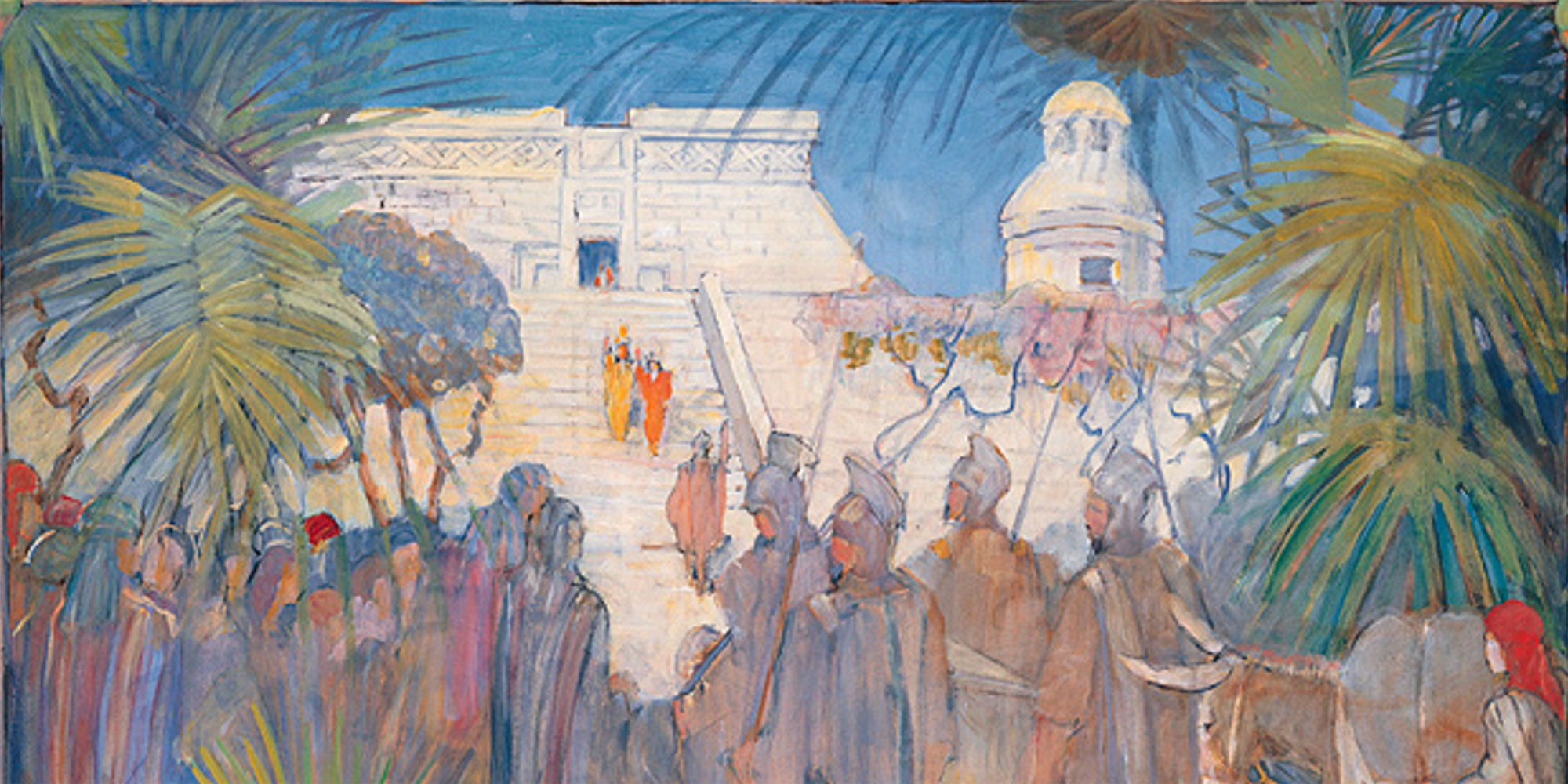
A lot happens in the short book of Omni, which spans 230 years of Nephite history. At the same time, much of it seems pretty cotidian. Is there some theme, some direction we are headed when we launch into the book? I think so. Something happens in a more intense way than anywhere else in the Book of Mormon—there is an intersection of scripture, covenant, and Jesus with family. Some wonder if, as LDS, we should be called the Church of Families more than the Church of Jesus Christ, but there is a reason for the emphasis. For one, the nuclear family is a microcosm for the family of man, as well as its learning ground. In scripture, the “House of Israel” typifies God’s house where all are invited. But there is something more granular, more practical, in how a focus on the family can further the work of the Lord. What we see in the book of Omni, which at first blush seems uninspiring, are fathers, sons, and brothers who, because they are intent on “keeping a genealogy” (v1), end up keeping the sacred records—preserved, polished, and with solid provenance—indeed, to keep genealogy is to write scripture. The Brass Plates was a record of the house of Joseph of Egypt, Lehi’s genealogy (1 Ne 5:14), but in keeping that ‘genealogy,’ scripture was formed. A commitment to family, to doing as one’s father had commanded, kept the scriptures bright and the covenant alive. Passing the plates from father to son to brother to king was, at the same time, the sharing of the covenant, the sharing in the covenant, “lineally and laterally” as one author put it. When we enter that covenant, we too commit to share the scriptures—lineally with our families and laterally to our sisters and brothers. The book of Omni begins by explaining how Omni received the plates and preserved genealogy, but it ends with the convergence not only of the four sets of records (small plates, large plates, twenty-four Jaredite plates, and the newly transcribed Mulekite oral history) but also the reuniting of a family who had once been together in Israel—the Nephites and the people of Zarahemla. And it’s the records which have been kept that makes it possible. This reunion, this at-one-ment, is the very purpose of the plates, and foreshadows what Nephi earlier prophesied about the final fulfillment of the union of scripture and family at the end of the world:
And it shall come to pass that the Jews shall have the words of the Nephites, and the Nephites shall have the words of the Jews; and the Nephites and the Jews shall have the words of the lost tribes of Israel; and the lost tribes of Israel shall have the words of the Nephites and the Jews. And it shall come to pass that my people, which are of the house of Israel, shall be gathered home unto the lands of their possessions; and my word also shall be gathered in one. And I will show unto them that fight against my word and against my people, who are of the house of Israel, that I am God, and that I covenanted with Abraham that I would remember his seed forever. 2 Nephi 29:13-14
On a similar note, I think it’s instructive that the word ‘contention’ is used more in the book of Omni to describe current conditions than in any of the books of the Small Plates. Nephi uses the word only in prophecies of the future. Jacob uses the word but only once and in the second to last verse of his final chapter (7:26). Enos is more worried over it than his father (1:23). In Jarom’s day it becomes a real threat (Jar 1:13). And by the time of Omni and his descendants, contention is woven into the fabric of their lives (v10, 17, 28). We see a gradual decline from the quarrels in Lehi’s family to real family infighting and finally to societal wars (incidentally, in the BM, contention is used 81x and in every case it refers to societal conflicts/wars and never to conflicts simply between individuals—what king Benjamin calls “quarrels” Mos 4:14). Why is this important? Because the book also shows us how to stitch families and nations back together across time. Omni says the point of the plates was to “preserve our genealogy” and in one sense, that’s exactly what the records and do—they preserve Jacob’s posterity, and they finally reunite a larger, Israelite family.
360 – 130 BC.
1 I, Omni, the name may be derived from a Hebrew root meaning “to be true, faithful” as well as “to confirm, support” (BM Onomasticon). to preserve our genealogy, similar to what Jarom said, and he may just be copying his father’s opening (see 1 Ne 3:3; Alma 37:3). Still, most writers in the Book of Mormon introduce their book by describing a slightly different purpose, and that’s useful so we know how to best understand their words. Here, Omni says genealogy, but perhaps what he’s really getting at is ‘family.’ Over these 230 years, Omni’s family—his descendants—despite looking like a typically complicated family bunch, are preserved (they survive the Nephite purge in v5); and the passing of the records seem to play a key role in their preservation. Here, kin and scripture meet. One author said it this way,
It’s like the story of the dying woman who requested that her surviving relatives take a family photo once a year. When questioned, she conceded that her real purpose was to make sure that the family got together at least once a year—the photo was incidental. Sharon Harris, Enos, Jarom & Omni: A Brief Theological Introduction
Moreover, the preserving of the plates ultimate leads to the union of two groups who’d once been family—the Nephites and the Mulekites—at the end of the book. Truly, by small and simply things… And how grateful I’m sure Mosiah was that all the records were kept when he unleashed them during the pivotal, life-or-death moment when his people first found Zarahemla. Just the fact that they existed (the Mulekites couldn’t even read them at that point), authenticated the record [as king Benjamin later said to his sons, “they are true; and we can know of their surety because we have them before our eyes” (Mosiah 1:6)] and so moved Zarahemla and his people that they welcomed them. The physical presence of the plates—with their self-declared chain of custody—certified their truth. So in this case, preserving genealogy was equivalent to creating scripture.

2 I fought much with the sword to preserve my people, so he was a soldier like his father, dedicated to help preserve the Nephites despite their problematic behaviors. I of myself am a wicked man, probably thinks that way because he was a soldier; or maybe he just doesn’t feel that he lived up to his father Jarom’s standard. Whatever Omni’s behavior, how grateful we should be that this is included, as it tells us that not only the ‘righteous’ get to write scripture. Holy text need not be exclusive to spiritual giants. In any event, none of the writers in Omni claim any kind of prophetic mantle in the ways that Nephi, Jacob, and Enos did. They do not describe their conversations and covenants with God, nor do they call the people to repentance; though they are intimately aware of the covenant and commandment to preserve the plates—and that’s what most matters. That’s what the Lord needs. The shift in the tone then of this book shouldn’t be resented, it should be appreciated for what it means, what it reflects, as I noted in my introduction above.
3 276 years, 318 BC. Per Jarom 1:13, Omni received the plates after 238 years had passed from leaving Jerusalem. So, from 238 to 276 is 38 years, meaning it appears Omni had the plates for 38 years before he wrote in them. Why now? Some have speculated that he was wounded in battle, and thought this might be it, but survived. The pattern, anyway, of these writers seems to be to simply write once (sometimes twice) at the end of their lives. yea, and in fine, 282 years, this was likely a new entry, six years later, else there would be no reason to add another date. 324 BC. And again why now? Likely he is about to die as he passes the plates to his son. many seasons of peace, and many seasons of serious war and bloodshed, interesting that he uses ‘serious.’ He should know. What were the many seasons of peace like?
4 I, Amaron, Amaron seems to have been a decent choice for record-keeper—he quotes scripture and prophecy for one; he writes more than his father, brother, and his sons; and he also survived the purge he describes in v7.
5 320 years, approx 276 BC. Most of the book of Omni happens during long stretches of war, occasionally interrupted by ceasefires. The authors of the book then, perhaps not coincidentally, write through the lens of being soldiers and witnesses to war. God chose the ultimate warriors Mormon and Moroni after all to be the final witnesses and record-keepers. more wicked part of the Nephites destroyed, Amaron may have associated this with the prophecies of the Nephite destruction (Jacob 7:25; Jarom 1:3). Another moment fitting the prophecy is 3 Ne 8 just before Jesus comes, as well as Mormon 6 of course.
6 he would not suffer that the words would not be verified, Amaron quotes prophecy but all in the negative, ‘not’, why? Probably just because it’s the negative then currently in effect. inasmuch as ye will not keep my commandments, ye shall not prosper, he couches the promise again in the negative, not surprisingly. This promise is not just from the BM, it goes back to biblical/Mosaic times, Dt 28:29. The way he says it though is different than how Lehi said it in the negative, which was that they would be “cut off from God’s presence” (2 Ne 1:20).
7 he did visit them in great judgement, see the promise the Lord made to his great-grandfather Enos, that he would “visit” the Nephites according to their “diligence in keeping my commandments” (Enos 1:10), or to clarify, their lack of diligence. did spare the righteous…deliver them, so Amaron interprets it as such, but war does not usually operate in such a surgically precise manner. Innocent people die in war. It’s also impossible for Amaron to know who is wicked and who is righteous, but his comments do reveal the Nephite worldview—that war was a tool for God to sort out who was good and who was evil—which is disturbing.
Amaron repeats the idea of prospering in the land, once again linking this phrase to warfare, just as Jarom did. As we wrote in the section on Jarom, we believe that this idea of “prospering in the land” is misunderstood. But we see here how a poor interpretation of an idea can be passed down from generation to generation and used in wrong ways, in this case to justify violence as God’s will. In all their references to “prosper in the land,” Lehi and Nephi either did not define “prosper” or they described it as being kept safe. For Lehi and Nephi, men who spent long stretches of their lives as refugees and victims of abuse, a land of safety would sound like a dream. For Jarom and Amaron, who live through generations of bloodshed, it would be very tempting to create a narrative that would make sense of the chaos inherent in war. So in the transfer of authors and change in circumstances, “prospering in the land” morphs from a place of safety to God leading the victors of battle, leaving deeply problematic theology in its wake. As readers, we can stand witness to that, offer a charitable heart to these men who lived in horrific times of violence, and simultaneously push back against the theology that does harm. Fatimeh & Salleh, The BofM For The Least of These
8 brother, why brother? See v9. He may have had no children, or only daughters. There are three other instances in the BM of records being passed to a brother rather than a son: Nephi to Jacob (Jacob 1:1–2), Helaman to Shiblon (Alma 63:1–2), and Amos to Ammaron (4 Ne 1:47).
9 I, Chemish, much more laconic that his brother Amaron; but like Amaron, he also survived the Nephite purge, so he must have been a decent guy, or just very skilled warrior ;). Moreover, Chemish fathered a son (Amaleki) who was open enough to revelation to flee with Mosiah to the land of Zarahemla.

few things, as his brother had said (v4), though Chemish writes fewer. His single verse distinguishes him as the BofM writer with the smallest amount of writing at 69 words. he wrote it in the day that he delivered them unto me, I don’t think the record keepers held the plates in light regard, so much as they regarded them more for what they represented than what they actually contained. after this manner we keep the records, had the process become formalized? Compare with Alma 37 and how solemn, formal, and lengthy Alma’s transfer process was with his son Helaman. We can learn what these authors’ transfer process may have been like by looking at Alma’s. While the book of Omni has the most plate transfers, Alma’s transfer to Helaman spells out the process and instructions of exchange at greater length than anywhere else. Among other instructions, he says, “and keep all these things sacred which I have kept, even as I have kept them; for it is for a wise purpose that they are kept” (Alma 37:2). Likely those who inherited the plates received a form of this instruction as well, to keep them sacred for a wise future purpose. One thing they may have been commanded to do, apart from writing (and perhaps even more important) was to actually keep them readable, i.e. polish them. I love this insight:
While instructing him to keep these things sacred, Alma gives an unexpected, pragmatic, and material detail: “if they are kept they must retain their brightness” (Alma 37:5). What does Alma mean? Is this another way of saying that Helaman should not only keep the plates, but that he should spiritually value them also [as Lehi used this metaphor about the brass plates that would not be “dimmed any more by time” (1 Ne. 5:18-19)]? Alma seems to have something else in mind. He is not declaring a grand destiny for the record. On the contrary, he offers a near-apology and explains himself. After he tells Helaman that the plates must retain their brightness, he protests, “Now ye may suppose that this is foolishness in me; but behold I say unto you, that by small and simple things are great things brought to pass” (Alma 37:6). When Alma says the plates must retain their brightness, he is talking about something small and simple. I think he is saying that the plates must be polished. Having just reiterated that both the small plates and brass plates will be preserved and go forth to all the world, is Alma really interjecting with a mundane reminder to polish the plates? If we take his words literally, yes, he is. The plates aren’t just to be stored but also to be kept, to be wiped clean and made smooth and shiny. Alma seems to think that if the plates are cared for at the level of polishing and burnishing them—making sure that they retain their brightness—they will be adequately kept or preserved to fulfill the prophecies and covenants associated with them…Alma and others clearly read from the small plates. In the 468 years between the time that Nephi first gave the plates to Jacob (542 BC) until Alma taught Helaman about his duties (74 BC), it hardly seems likely that the plates would have remained readable without polishing and care. Sharon Harris, Enos, Jarom & Omni: A Brief Theological Introduction
I love the image of these record-keepers, who spent very little time engraving, instead regularly spending time “preserving’ or actually polishing the plates! This may have been part of the commanded ‘manner’ of keeping the plates.
10 I Abinadom, there doesn’t seem to be a passing off here. I have taken the lives of many Lamanites, Jacob’s lineage, at least post Enos, all seem to be soldiers. in defence of my brethren, suggesting that the Nephites were not the aggressors.

11 the record of this people…is had by the kings, he’s clear that what he keeps is not a record of the people, it’s something else. His job is rather to preserve what’s been written than keep a further record. I know of no revelation, this is different from Jarom who, along with others in his day, had received many revelations. In any event, importantly, Abinadom is aware of the plates’ purpose, and aware of the ancient prophecies. More time, study, and thought may have been put into this conclusion than we think. After all, he was likely the steward of the record during the exodus, Amaleki being too young at that time to have received the plates. So Abinadom was among those who heeded the “voice of the Lord and fled with Mosiah (v12, 23). that which is sufficient is written, as opposed to that which is written is sufficient, or adequate enough. His reversal suggests he first considered the purpose and destiny of the plates, and then compared that to what was written. I make an end, Abinadom’s failure to mention the recipient of the plates—which has been the pattern so far—could suggest that Amaleki was too young at his father’s death to receive them directly. They could have been held by a brother or some other steward.
12 I Amaleki, after reading Amaleki’s account, it appears his entry is retrospective and in one sitting, as the previous authors of the Book of Omni seem to have done. Significantly, his 919 words is more than the entire book of Jarom. Mosiah who was made king over the land of Zarahemla, who was Mosiah? Was he a king? Son of a king where there were rivals vying for power? A coo to take out the kings and his life was in danger? He seems to have been someone of power given he is later made king in Zarahemla. Certainly he was at least a prophet, priest, or spiritual leader of some sort. He must also have been a descendant of Nephi as he was keeper of the records, Liahona, and sword of Laban (unless he stole them, as Nephi did, he he). he being warned of the Lord that he should flee out of the land of Nephi, same as Lehi (1 Ne 2:2; 2 Ne 5:5-6). This flight was prophesied in Jacob 3:4. Was there an attack by the Lamanites? When Zeniff returns to the Land of Nephi, there doesn’t seem to be any Nephites left, and the Lamanites are in charge (Mosiah 9:6-8). So, Nephites could have been killed in a war, but more likely there was some political alliance and the Nephites who remained simply became ‘Lamanites,’ or adopted their culture, etc. and as many as would hearken unto the voice of the Lord should also depart, there could have been two reasons for this: (1) the Lamanites were about to attack, or (2) the Nephites were going to capitulate politically in some way; possibly for both reasons, though the latter seems to explain things better. out of the land…into the wilderness, in the BM, wilderness refers to mountain lands, forests, and dense jungles. The word actually means uninhabited areas. It’s also an archetype. God works this way. He literally takes his chosen people out of a land and into the wild towards a promised land, but he also takes us out of our comfort zones, literally or metaphorically speaking, and on a journey of growth and learning through significant challenges, ultimately toward a better and more developed place. On an archaeological note (I love these insights):
Why did Mosiah choose to go in the direction he did? Yes, Yahweh was leading him, but it was also a natural direction. As John Sorenson notes, the Book of Mormon never mentions traveling south out of Nephi. The more northerly direction (through the wilderness area) was a known trade route. Trade routes are difficult to trace archaeologically, but they may be presumed when an identifiable trade good moves from one location to another. In the case of Kaminaljuyú (Sorenson’s city of Nephi), a major export was obsidian, which had a nearby source and was even worked in Kaminaljuyú. The volcanic processes that produce obsidian are so distinctive that pieces can be accurately traced to their source, even from many miles away. The Kaminaljuyú obsidian is known as El Chayal. El Chayal obsidian was traded down the coast during the early years of the Book of Mormon period; but at Mosiah’s time period, a distribution channel had been developed that traded El Chayal obsidian into Veracruz, northwest of Kaminaljuyú. Thus, an established route and the assurance of friendly town(s) to the northwest help explain Mosiah’s flight in that direction. Brant Gardner, Second Witness
13 they were led by many preachings and prophesyings, Jacob prophesied of this even in Jacob 3:4. admonished continually by the word of the Lord, obviously there’s a story here which is no doubt recorded on the Large Plates. led by the power of his arm, an allusion to the Lehites’ escape from Jerusalem (Jacob 2:25). through the wilderness…down into the land which is called the land of Zarahemla, since they’d been struggling through the wilderness for many days, they would have been bedraggled and hungry refugees in need of food and rest. More fascinating insight into what the journey may have been like:
While there are many “wildernesses” in the Book of Mormon, one stretch of “wilderness” is consistently described as a buffer between the land of Zarahemla and the land of Nephi. Sorenson summarizes:
“In late B.C. times a continuous wilderness strip separated Nephite Zarahemla from Lamanite territory. Furthermore, at least during the events recorded in the books of Mosiah and Alma, the city of Nephi (also called Lehi-Nephi) was some distance from the “narrow strip of wilderness” proper. On the Lamanite side of the border zone considerable wilderness space seems to have separated the city of Nephi from the transition strip. A good deal of searching for lost lands, marchings and countermarchings of foes, and wilderness travel went on in that extensive space. (See, for example, Mosiah 19:9–11, 18, 23, 28; 23:1–4, 25–31, 35; Alma 17:8–9, 13; 23:14, in light of verses 9–12; 24:1.)”
Sorenson suggests as this “wilderness” the mountain range along the north/ northwest border of the valley of Guatemala that separates that area from the Grijalva River Valley, his candidate location for Sidon. Thus, Mosiah leads his people out of the land of Nephi, moving generally toward Zarahemla and passing through the “wilderness” which, in this case, is a mountainous strip.
Coming out of the “wilderness,” the people of Mosiah go “down” to Zarahemla. Sorenson further points out that, in the ancient world, “up and down” refer to elevation, not cardinal direction. Zarahemla is consistently “down” from the land of Nephi. This makes sense as Zarahemla is located along a river, and the river necessarily is in the lower elevations of its valley. Even so, highland Guatemala is yet a higher elevation than the Grijalva River basin. The real-world topography fits the consistent references to it in the Book of Mormon.
We do not know how long the journey from Nephi to Zarahemla took, but it was not necessarily short. Ammon’s journey between Zarahemla and the land of Nephi lasts forty days (Mosiah 7:4), and Alma’s people traveled in the opposite direction for twenty-one days according to Sorenson’s reconstruction from textual hints, though over a somewhat lesser distance. The discrepancy between the two journeys appears to be related to the geography of the area, where the headwaters of two rivers are close together.
There is no easy way to calculate the time Mosiah’s people required to travel the 180 miles that Sorenson estimates for Mosiah’s journey. The description of the journey, particularly that the people were “admonished continually,” suggests that the journey was long enough that the people’s patience was tried to the point where Yahweh needed to “admonish” them. They were guided through the wilderness, but we must remember that Israel was also guided and supported by Yahweh’s arm in their “wilderness,” and their journey lasted forty years. Furthermore, there is no indication that Yahweh guided them by the most direct route. Rather, it sounds as if the Lord pointed them in the right direction but that they had to find their own way there. It would not be unreasonable to assume that the journey took at least the forty days Ammon’s group required (Mosiah 7:4–5), perhaps longer, given the large group of Mosia’s people. However, the number forty should not necessarily be taken literally. It had long been a generic number in the Old World, a tradition that may have survived in the New World. Even without that influence, it is culturally significant in Mesoamerica, where the number systems are built on base twenty. The number appears frequently in Mesoamerican descriptions, indicating that it is also likely to be some type of generic number.
During their trek through the wilderness, they would have had to subsist on the land as they probably left in some haste (“flee”) and could not completely provision themselves for travel. Although they were city dwellers, it seems likely that they also regularly supplemented their diet by hunting and would have increased their amount of hunting on the march. No doubt they also gathered wild plants and fruits en route. Brant Gardner, Second Witness



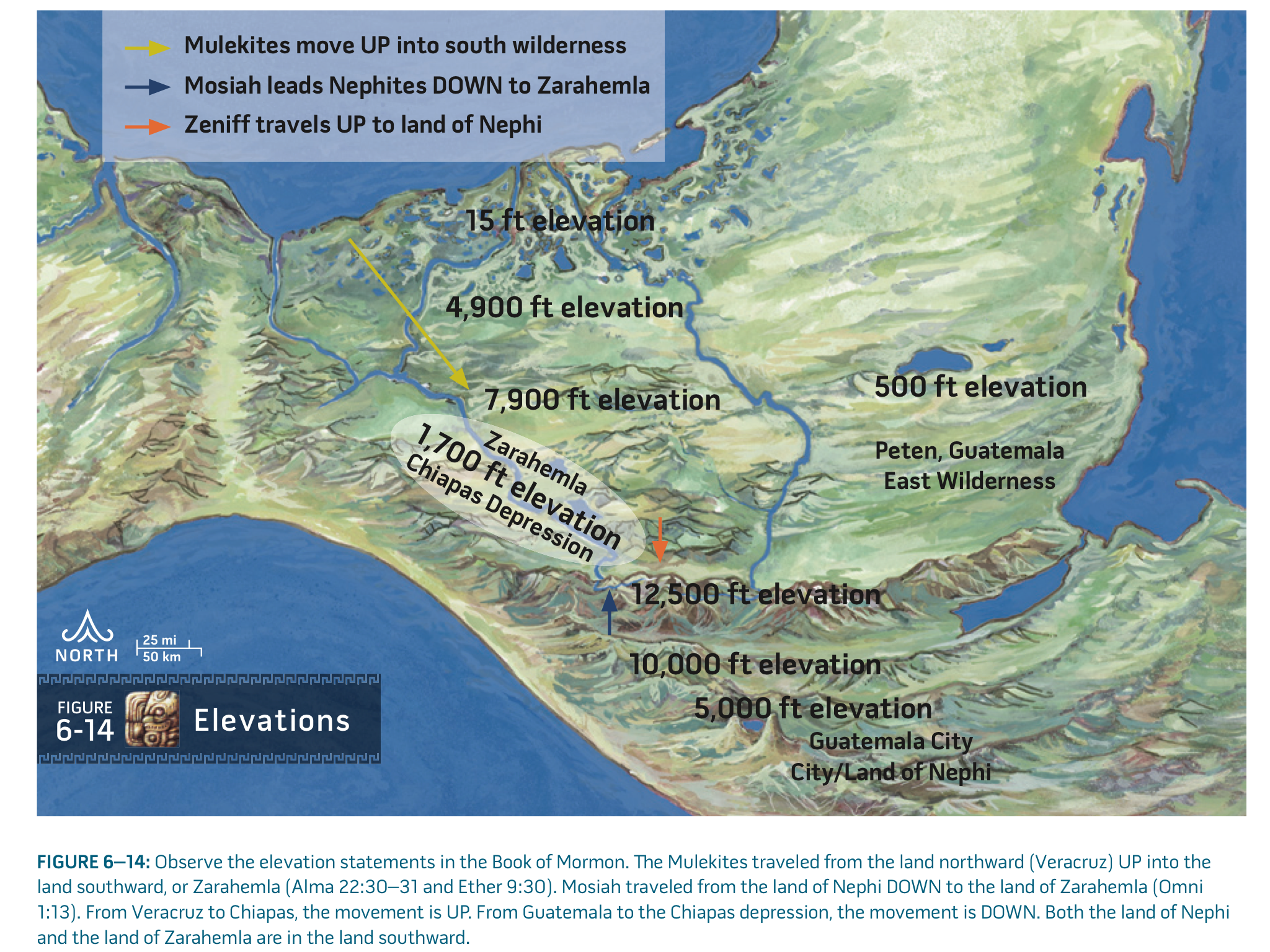

John Sorenson suggests the site of Santa Rosa along the Grijalva River as his candidate for the location of Zarahemla:
“The largest archaeological site on the upper Grijalva in an appropriate position to qualify as Zarahemla is Santa Rosa. . . . By 1974 the site had been inundated by waters backed up nearly 70 miles behind Angostura Dam. . . .
“Linguistic research tells us that the upper Grijalva lay at the juncture of two major areas where long-established peoples and their languages existed. A couple of thousand years ago the Mayan languages probably extended throughout much of Guatemala to about the mountainous wilderness strip that separates the highlands of that nation from the Grijalva River valley. Downstream, from near Chiapa de Corzo and extending north and westward, were speakers of Zoque dialects; in the isthmus proper was the closely related Mixe language. Both blocs, the Mayan speakers on the Guatemalan and groups using tongues of the Mixe-Zoquean family on the isthmian side of Santa Rosa, had been there a long time. Ancestral Mixe-Zoquean has been shown to be the probable language of the Olmecs of the Gulf Coast, while Mayan speakers likely had been in the Cuchumatanes Mountains of Guatemala since well before 1000 B.C. (Evidence is uncertain, however, whether Mayan languages were spoken until post-Book of Mormon times in the actual areas of the southern Guatemalan highlands where the Nephite and Lamanite settlements are best placed.) But neither major language group seems to have been established on the upper Grijalva, at least not until well into A.D. times. That intermediate zone seems to have been a linguistic frontier. Zarahemla’s people had moved into the area from the Gulf Coast through lands occupied by Zoque speakers for centuries. His local followers in Mosiah’s day likely spoke a language like Zoquean. Mosiah and his party, coming from the opposite direction, were among the first of a long series of groups who drifted down out of Guatemala into this valley over the next thousand years.
“The archaeological sequence at Santa Rosa is interesting in terms of the Book of Mormon, although the findings will always remain incomplete because the site is now underwater. Major public construction in the form of what seem to have been “temple” or “palace” foundation mounds started on a modest scale at approximately 300 B.C. That coincided with growth in population, which produced the “city” of Zarahemla that Mosiah’s party encountered a couple of generations later. The place remained no larger than a modest town, as we think of size, during the time when Mosiah, Benjamin his son, and Mosiah II reigned. Around 100 B.C. a spurt in the city’s prosperity is evident, and a large number of major public structures were erected. That condition continued for around a century. Except for the site of Chiapa de Corzo far downstream, Santa Rosa became the largest, most significant “city” in the Grijalva basin just at the time when Zarahemla is reported by the Book of Mormon as becoming a regional center.
As Sorenson points out, an interesting combination of factors reinforces Santa Rosa as the potential site for Zarahemla. The archaeological indication of a population explosion in Santa Rosa soon after Mosiah1 and his people entered Zarahemla is quite suggestive. While the linguistic data do not tell us much at the moment, the position of Zarahemla along a linguistic and probably cultural frontier will certainly impact our understanding of some of the events later discussed for Zarahemla. Brant Gardner, Second Witness
great rejoicing…with the plates of brass…the record of the Jews, because of the records, yes, but also a shared history. Amaleki is probably conflating details of events that occurred at different times, because the reality of what first happened on their arrival would have been different. The Mulekites would first have had to determine if Mosiah and his people were a threat, a military patrol of some sort; and Mosiah also would have had to be cautious about being attacked. In their negotiations, the presentation of the plates may have been what changed the nature of the transaction and caused the rejoicing. And as the genealogy connection came later (v18), the ancient records on precious metals may have served a “talismanic function” identifying Mosiah as an important man.
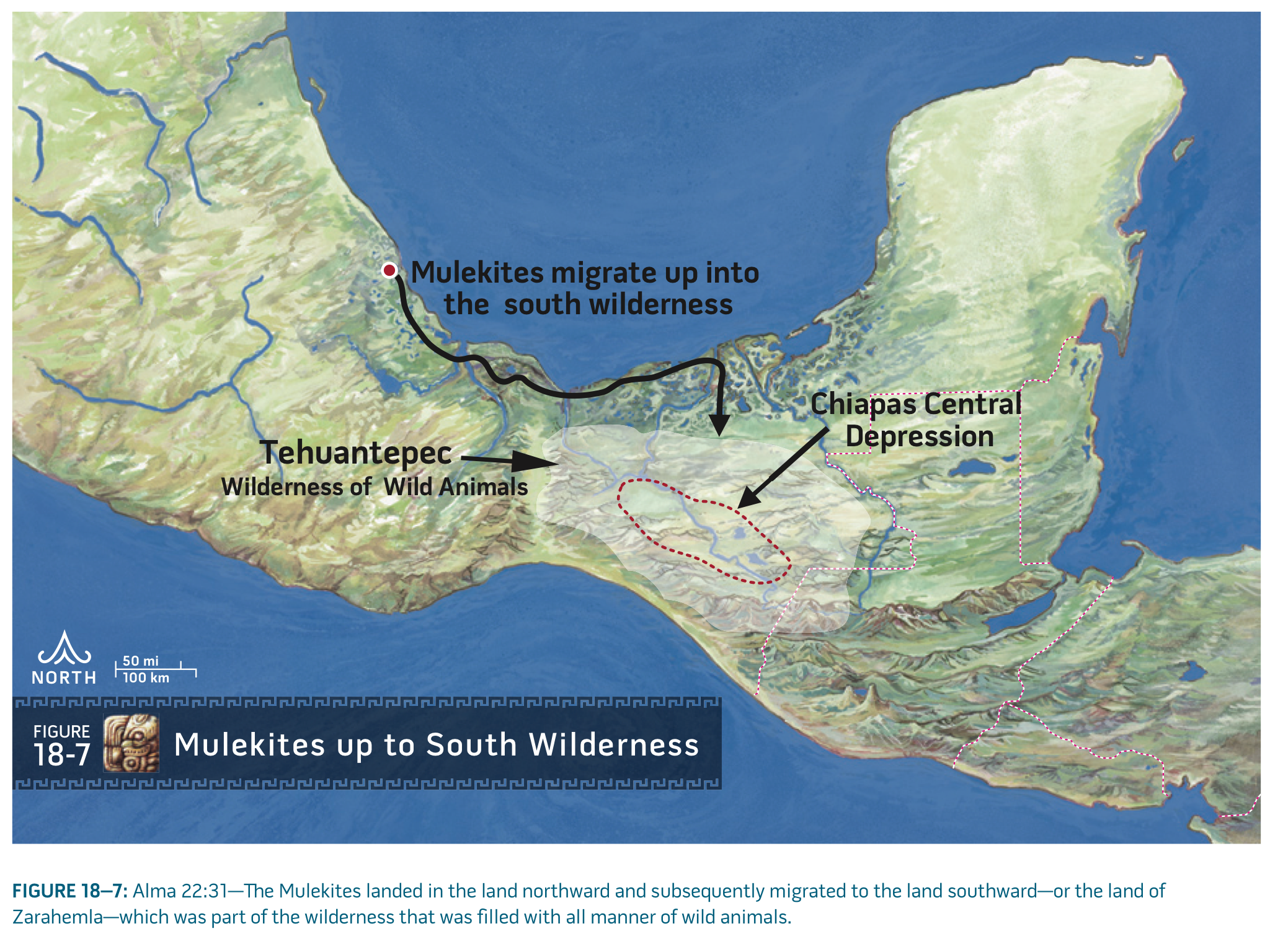
14 the people of Zarahemla, Mulekite remnants/mixtures (Mos 25:2; Hel 6:10; 8:21). A leader named Zarahemla (as lands were typically named after founders) may have led this group out of the land of their original inheritance from further north on the Atlantic coasts (Alma 8:7; also 22:31 which says they went south). So this group may have only been a remnant, a small colony, of the original Mulekite group who by now, some 400 years later, were scattered all over the North, long subsumed in the indigenous (probably Olmec) culture. We’re not told how long this group had been here.

15 came out from Jerusalem at the time of Zedekiah, perhaps a decade after Lehi. carried away captive into Babylon, in short, Zedekiah reigned from 597 B.C.E. to 586 B.C.E. Lehi was called as a prophet in the first year of his reign (1 Ne. 1:4), and Mulek left shortly after his reign ended. In vengeance for Zedekiah’s treachery, Nebuchadnezzar killed his sons before his eyes, then blinded Zedekiah and carried him off to Babylon (2 Kgs. 25:7). The Bible reports no other details, but the Book of Mormon makes it clear that a son named Mulek avoided the fate of his brothers and crossed the ocean as part of the group that eventually becomes the people of Zarahemla (Mosiah 25:2, Hel. 8:21).
“Mulek” appears as “Muloch” in the printer’s manuscript of the Book of Mormon and as “Mulok” in printed editions from 1830 to 1852; the name then became “Mulek.” However it was pronounced, the name comes to us of course as Nephite ears heard it from the people of Zarahemla, and their pronunciation could have changed it somewhat from the Old World Hebrew familiar to us. What is clear throughout these variations in the spelling of the name is that we have here a reflex of the Hebrew root mlk, as in Hebrew melek, “king.”
Nowhere in the Bible are the children of Zedekiah enumerated, let alone named, although we are told that he had daughters as well as sons (Jer. 43:6, 52:10). He was twenty-one on his accession to the throne. Being a noble, he already had the economic resources to have possessed a wife and child(ren) at that time. After his accession, he took multiple wives in the manner of the kings of Judah before him (Jer. 38:22–23 refers to Zedekiah’s “wives”) so that when he was captured at age thirty-two, he might have had a considerable progeny.
Robert F. Smith has mustered evidence that a son of Zedekiah with a name recalling Mulek may actually be referred to in the Bible. Jeremiah 38:6 in the King James translation speaks of Jeremiah’s being cast into “the dungeon [literally, “pit”] of Malchiah the son of Hammelech.” The last five words should be rendered more accurately, “Malkiyahti, the son of the king.” This personal name could have been abbreviated to something like “Mulek.” Thus Jeremiah might have been put into “the [very] dungeon of Mulek[?], the son of the king [Zedekiah]” referred to in the Hebrew text of Jeremiah 38:6.18. John L. Sorenson, quoted in Brant Gardner, Second Witness
16 they journeyed in the wilderness, but how did Mulek escape? BM scholars suggest four possibilities: (1) Mulek was only a baby and those who took charge of him literally carried him away, (2) Mulek was disguised as a daughter and taken to Egypt, (3) Mulek’s mother was pregnant at the time and escaped the wrath of the Babylonians, (4) Mulek was born much later while the blind Zedekiah was in captivity. were brought by the hand of the Lord across the great waters, another great story hopefully written somewhere. they had dwelt there from that time forth, Sorenson identifies the site of La Venta as the city of Mulek. They landed in the North (Hel 6:10, Atlantic shores, also near the Jaredite territory called “Desolation” Alma 22:29-30) as opposed to Lehi’s landing in the south on the Pacific side.

17 exceedingly numerous, they obviously also mixed with the indigenous population. In their original city of Mulek in the north (possibly La Venta), they would have adopted the culture of the Olmec—the oldest major Mesoamerican civilization (1500-600 BC), but who were on the decline at that time.
Assuming that they acquired the language of the Olmec area, they would have learned common Zoquean or common Mixean. If Sorenson’s candidate location of Zarahemla in the Grijalva River Basin is correct, the Zarahemlaites would have been in territory historically associated with Zoque speakers. I hypothesize that the Zarahemlaites/Mulekites were part of the historical movement of Zoquean speakers from the Oaxacan area up the Grijalva River Valley. It is perhaps because of their linguistic affinity with Zoquean speakers in the area that Amaleki described the Zarahemlaites as “exceedingly numerous”; he meant the speakers of the lingua franca of Zarahemla were exceeding numerous, not specifically those in residence in Zarahemla. Brant Gardner, Second Witness
many wars and serious contentions, wars with local indigenous peoples, but possibly contentions among themselves. language had become corrupt…they had brought no records, both the corrupt language and the denying the Creator are written here by Abinadom in the context of not having brought the records with them. This would confirm why the brass plates were so important, and their underlying power during the last 400 years. In the context of these recent BM authors, it’s instructive that although their writings on the Small Plates were limited, the records they kept still provided a continuous linguistic and spiritual foundation for Nephite society (2 Ne 4:12-18; Mos 1:3-4). Then again, saying the language was corrupted is a judgement call—why corrupted rather than simply changed over time? The Nephite languages also, in time, became ‘altered’ (a more generous view) according to Moroni (Morm 9:33). Also,
It does not seem reasonable that possession of texts would have stopped or even necessarily slowed the pace of linguistic change. More probably, it is simply that, without records, there was no reason to preserve a language whose speakers could communicate only with a group of others that shrank with every generation. There was no reason not to adopt the language of the people among whom the Mulekites found themselves. Brant Gardner, Second Witness
denied the being of their Creator, as already noted, one effect of the absence of records would have allowed the very rapid disappearance, possibly within three generations, of Hebrew speakers. The second effect was the loss of their religion. Without scriptures, the Zarahemlaites lacked conceptual religious anchors and made them more susceptible to the influence of local religions, which Amaleki calls, predictably, apostasy.
18 Mosiah caused that they should be taught in his language, everyone or just rulers? Also,
The people of Zarahemla lose their government, faith, language, records, and probably other aspects of their culture. This is an act of colonization, even if the Nephites acted with good intentions. Fatimeh & Salleh, The BofM For The Least of These

after they were taught, ya, must have taken a while, though we may be just talking about the leaders. Note it was also ‘after they were taught’ that Zarahemla gives his genealogy. Orson Scott Card provides an interesting alternative reading of Zarahemla’s background:
Let me offer an aside on the matter of Zarahemla and the Mulekites. Much has been made of the statement by King Zarahemla that his people were descended from the youngest son of King Zedekiah. Extraordinary and completely unconvincing efforts have been made to find such a son, overlooked by the Babylonian captors of Jerusalem; just as much effort has been devoted to explaining how a good Jaredite name like Mulek could show up in the family of an Israelite king. But is this really necessary? In Meso-American culture, every ruling class had to assert an ancient ancestor who was a god or, at the very least, a king in an admired culture. Whoever ruled in the Valley of Mexico always had to claim to be descended from or heirs of the Toltecs. Rival Mayan cities would play at ancestral one-upmanship. Imagine, now, the vigorous and dangerous Nephites, coming down the valley of the Sidon River from the highlands of Guatemala. King Zarahemla is negotiating with King Mosiah. Mosiah tells him of his ancestry, of course, and the story of how God led Lehi and Nephi out of Jerusalem at the time when Zedekiah was king of Israel. To Mosiah, what he is doing is bearing his testimony and asserting the divine guidance that he receives as the legitimate king of a chosen people. To Zarahemla, what he is doing is claiming that his lineage gives him the right to rule over the people of Zarahemla and displace him from the kingship. So what does Zarahemla do? Well, Mosiah admits that his ancestors were not kings in Israel. So Zarahemla picks his most noble ancestor, Mulek, and then declares him to be the son of that last king of Israel. Thus if anybody has the right to rule over anybody, it’s Zarahemla who has the right to rule over Mosiah and his people. But Mosiah kindly points out that if Zarahemla and his people are descended from Israelites, they certainly seem to have forgotten the language and writing, and therefore have obviously degenerated from the high culture of Israel. The Nephites, on the other hand, have preserved a writing system that no one else uses, and which Zarahemla can’t read. They have a history accounting for every year since they arrived in America, which Zarahemla of course cannot produce. In the end, whatever negotiation there was ended up with Zarahemla bowing out of the kingship and his people becoming subject to rule by the Nephites. But the story of Mulek served a very useful purpose even so—it allowed the people to merge, not with the hostility of conquerors over the conquered, though in fact that is what the relationship fundamentally was, but rather with the idea of brotherhood. They were all Israelites. Orson Scott Card, The Book of Mormon: Artifact or Artifice? BYU Speech, Feb1993.
Zarahemla gave a genealogy of his fathers…according to his memory, why does he not say Zarahemla was a king (it seems he would have certainly been)? Was it to downplay later potential claims to the throne?
A Mayan practice at the time of the Spanish conquest shows the principle governing how to get along in strange territory: When anyone finds himself in a strange region and in need, he has recourse to those of his name [kin group]; and if there are any, they receive him and treat him with all kindness. [Note when Alma identifies himself to Amulek as a “descendant of Nephi” (Alma 10:2-3) in order to establish that they were of the same lineage.] Understandably, therefore, one of the acts in dealing with the newcomers emerging from the wilderness would be to examine genealogies to ascertain possible kinship obligations. Brant Gardner, Second Witness

they are written, but not on these plates, now that Mosiah has introduced writing to the people, they can record these memories.
19 unite together, I mean, honestly, it must have been pretty cool that after 400 years these groups came together with their common ancestry and history in coming over from the Old World. 400 years is a long time. Notably, the Nephites were a smaller group joining a larger one. Despite the merging, their language, material culture, and religion were all different, and the inevitable tensions will lead to political and religious tensions later in Alma. Mosiah was appointed to be their king, as one scholar wrote, “the lamb ate the lion,” meaning the smaller population dominated the larger; possibly because he was associated in some way with the Nephite kingly line—he does have the royal records and relics after all (Mosiah 1:16). And yet the descendants of Mulek could have claimed the rights and succession of Davidic kingship, and they were more numerous (Mos 25:3). Why didn’t they?
It would have been unusual if Nephite became the dominant language of the area. Correlating language to geography suggests that the Nephites brought perhaps a Hebrew and/or Maya heritage to the merger, while the Zarahemlaites contributed a Zoquean linguistic and Epi-Olmec cultural background. The persistence of Zoque in that geography throughout discernable history suggests that Nephite (whatever that exact language may have been) did not become the dominant language of the Zarahemlaites and therefore of the future Nephites. If anything, Zoque probably became the Nephites’ daily language soon after their arrival in Zarahemla. Brant Gardner, Second Witness
When Mormon abridged the record, he would have had a fuller account of the Nephite/ Zarahemlaite merger than that offered by Amaleki, but his account was lost with the 116 pages.
20 large stone brought…with engravings, Mesoamerica is unique in the Western hemisphere for its writing systems. While the best-known is that of the Maya, the roots of literacy probably go back to the Olmec. Part of that tradition includes inscriptions on stelae, or large stones. It must have been a smaller stelae if it was “brought” to him. he did interpret…by the gift and power of God, this seems to go back to Jarom’s comment that the kings and rulers were mighty men of God (Jar 1:7). Did he use “interpreters” or “Urim and Thummim?” Apparently so, as later his grandson Mosiah is said to have “wherewith he can look and translate all records” (Mosiah 8:13-19; Alma 37:21-25). Joseph Smith adopted this phrase for his own explanation of how he translated the gold plates ‘by the gift and power of God.’
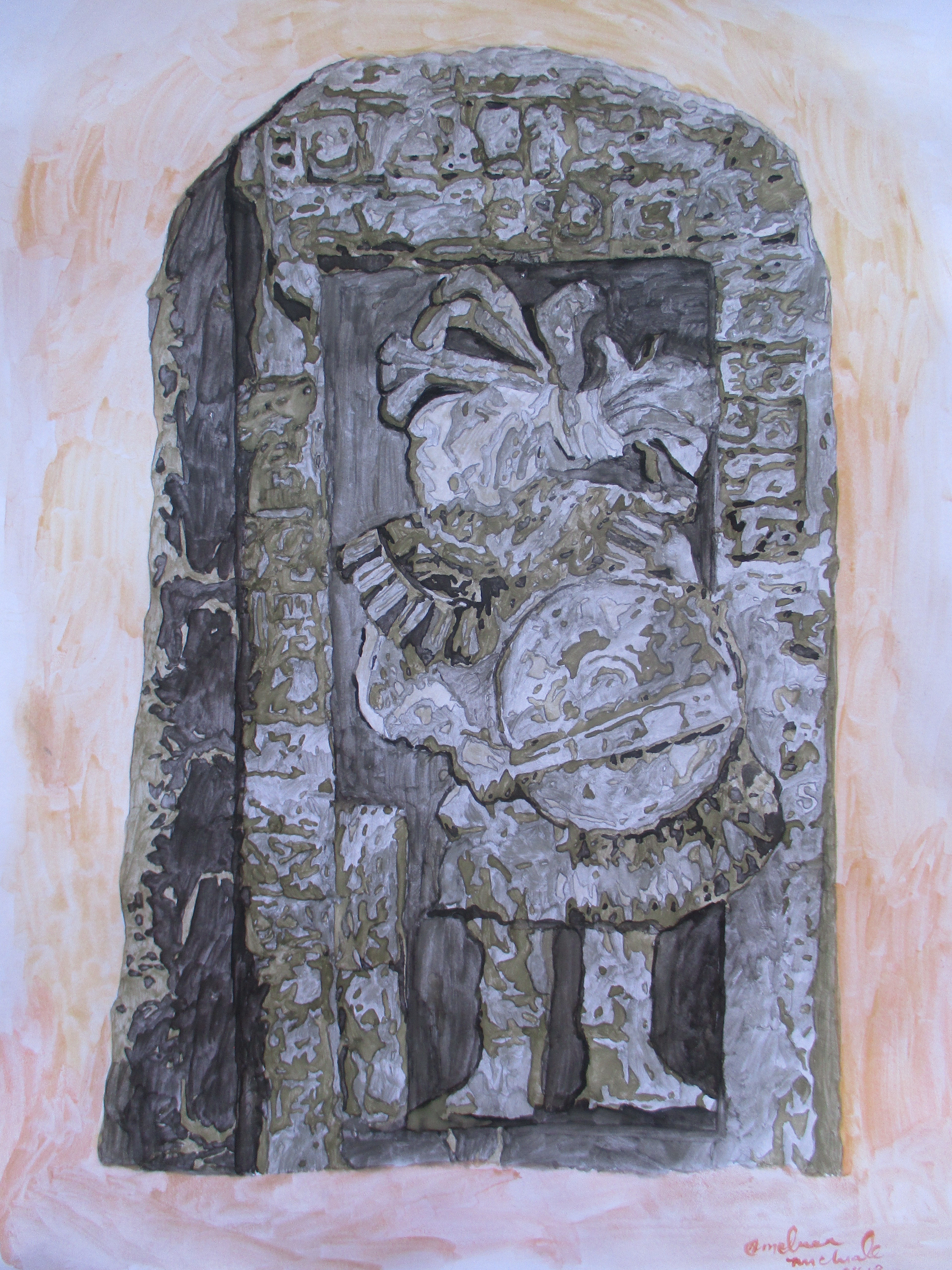
21 Coriantumr and the slain of his people, Jaredites. This account is in the book of Ether. In Mesoamerica, victory was frequently commemorated with stelae engravings, but Coriantumr lost the war, at least both sides were all wiped out, so it’s an odd find. Who was the carver? Some suggest Mosiah just used the stone and whatever was engraved on it as a prophetic means to reveal the story of the Jaredites. discovered by the people of Zarahemla…dwelt with them…nine moons, or 9 months.
22 came out from the tower…confounded the language, etc. More on this when we get to the book of Ether. severity of the Lord fell…judgments are just, hmm, interesting. Why say this? Same phrase in Mos 3:18; 16:1; 29:12; Alma 12:15; 14:11; 2 Ne 26:7; Jn 5:30. their bones lay scattered in the land northward, later the 24 plates containing the record of Ether will be found. Mosiah 8:8.

23 born in the days of Mosiah, implying that Mosiah had already begun his reign, though not certain. lived to see his death, so Amaleki was younger than Mosiah. Benjamin, his was an extraordinary family, as we’ll see. Did contentions arise at the death of Mosiah from others who claimed rulership, and did that spawn the wars mentioned in the next verse?
24 I have seen…a serious war, so it doesn’t look like Amaleki was a soldier, which would make some sense if he was born and raised post-exodus. In any event, either the Lamanites had followed the Nephites into the land of Zarahemla or the ‘Lamanites’ reference is simply to nearby non-Nephites with whom the Mulekites had already been in conflict. king Benjamin did drive them out of the land of Zarahemla, Benjamin was a soldier who fought for his people, which apparently was the order of the day for Mesoamerican kings. between the Nephites and the Lamanites, Zarahemla’s people are now completely absent, subsumed under the label “Nephite,” at least per the text. We’ll see later in Mosiah and Alma, when there are disputations over kingship, that there were still divisions among the people in how they identified themselves. Remember, Lamanite is a collective term for anyone who opposes the Nephites (Jacob 1:14).
25 old…no seed, or no sons. I shall deliver up these plates unto him, meaning king Benjamin, and once again the plates are all together in the hands of one man. This hadn’t happened for 300 years! exhorting all men to come unto God, the Holy One of Israel, even Jesus Christ, the Son of God, the Messiah, and believe, this is a great list—prophesying, revelations, ministering of angles, gift of tongues, interpreting languages, etc. ‘tongues’ may have to do with how they overcame the language barriers with the Mulekites. This verse, this entire chapter in fact, likely had a huge influence and effect on Joseph Smith. Here we see the gift of seership, seeing things in stones and interpreting languages, receiving visions and ministering of angels, revelations, etc.—there was precedence to what Joseph was experiencing. and in all things which are good…nothing which is good save it comes from the Lord…and that which is evil cometh from the devil, Mormon will expand on this in Moro 7:12, 16–17; 10:13–16; cf. Alma 5:40.
26 my beloved brethren, using one of Jacob’s favorite phrases. Amaleki was clearly familiar with the records, unlike the few authors before him so it seems. come unto Christ, the Holy One of Israel, 2 Ne 25:29. partake of his salvation and the power of his redemption, it’s a present tense invitation—portraying salvation as immanent—right here, right now, in the same way Jarom taught the people to believe in the Messiah “as though he already was” (Jarom 1:11). offer your whole souls as an offering, allusion to the burnt offering in the Mosaic law. ‘whole soul’ is also an Enos expression. continue in fasting and praying…endure to the end…as the Lord liveth, ye will be saved, Mormon will end his book, as will Moroni, in the same way Amaleki does. This book was obviously influential. And remember, Mormon intended to end the Book of Mormon with this book. “Wherefore, I chose these things [small plates] to finish my record upon them, which remainder of my record I shall take from the plates of Nephi; and I cannot write the hundredth part of the things of my people. But behold, I shall take these plates, which contain these prophesyings and revelations, and put them with the remainder of my record, for they are choice unto me; and I know they will be choice unto my brethren” (Words of Mormon 1:5–6). Even before he had finished abridging the larger plates of Nephi, Mormon decided that these small plates would finish the record. Accordingly, he put them at the end, making this book of Omni the end of the entire Book of Mormon.
Omni 1:25-26 – Citing Predecessors in a Farewell – Amaleki brings the Small Plates to an end by incorporating some key phrases from the Nephite founders into his last words:
| Amaleki | ||
| I began to be old | Jacob | I, Jacob, began to be old (Jacob 7;26) |
| Enos | I began to be old (Enos 1:25) | |
| exhorting all men to come unto God | Lehi | all men come unto God (2 Ne 2:10) |
| come unto…the Holy One of Israel | Jacob | come unto the Holy One of Israel (2 Ne 9:51) |
| come unto Christ… and partake of | Nephi | come unto him and partake of his goodness his salvation (2 Ne 26:33; with “partake of his salvation” in vv. 24, 27) |
| the power of his redemption | Jacob | the power of the redemption (Jacob 6:9) |
| endure to the end… ye will be saved | Nephi | if ye…endure to the end, ye shall be saved (1 Ne 22:31; 2 Ne 31:15) |
When Moroni concludes the Large Plates, he will adopt a similar strategy in Moro 10:24–34, with parallels to Amaleki’s list of spiritual gifts here (see Moro 10:13–16).
27 a certain number who…returned to Nephi, see Mosiah 9. About 200 BC, given the dates we’re later given. These last four verses are clearly an afterthought. Why add them now? Probably because of his brother (see note below). Amaleki is about to die, and his brother has been missing possibly for years. In his final moments, even while concluding scripture, he thinks of his brother. large number desirous to possess the land of their inheritance, why were they so desirous to possess that land? Why mount a military expedition that had to travel 180 miles through wilderness before even meeting their enemies? Possibly for the wealth of the city of Nephi (Kaminaljuyú) compared to Zarahemla’s (Santa Rosa’s) poverty—nostalgia for the lost “good life,” like Laman’s and Lemuel’s longing for their comfortable life back in Jerusalem.
28 the wilderness, back south, was the route easy to find? leader being strong, mighty, stiffnecked, we don’t know who this is. contention, all slain save fifty, see the other account of this in Mosiah 9:1-2. The third time the word ‘contention’ is used in this chapter (v10, 17, 28). they returned, there could be a lesson here in not pining for the past, what we’ve given up, what the Lord has led us away from. Think Lot’s wife.
29 took their journey again, really? This time Zeniff led them. Their account begins at Mosiah 7:1.
30 I had a brother who went with them…not since known concerning them, and this may be why he mentioned the event at all.

As if bursting suddenly out of him, he forlornly seems to say, “I have a brother. Do you know where he is?” In the final, minimal space left on these plates that already have lasted hundreds of years, he wants to at least mention his missing brother. These are records destined for fraternal finding and redemption…This is the invitation of the itty bitty books and the whole Book of Mormon: you are your brother and sister’s keeper. Reading the book gives you access to the covenant. As God instructs Enos, go to—gather the rest of the world as well.
these plates are full…I make an end of speaking, BoM authors sometimes conflate speaking and writing; cf. v. 12; 1 Ne 14.30; 2 Ne 25.1–3; 31.2; 32.7; 3 Ne 28.24; Morm 8.13.

There are twenty-two record transfers from Nephi down to Moroni. Fifteen of the transfers are lineal. The small plates have three lateral moves: Nephi to his brother Jacob, Amaron to his brother Chemish, and Amaleki to his king, Benjamin. From Benjamin the plates move lineally to Mosiah, but then they move laterally to Alma the Younger. Alma the Younger passes lineally to Helaman1, who passes laterally to his brother, Shiblon, who then, to keep things interesting, passes laterally to Helaman’s son, Helaman. The plates pass lineally for several generations until Amos, who passes laterally to his brother, Ammaron. (It is rather poetic to have Am[m] arons in fraternal exchanges flanking the early and late stages of the plates’ circulation.) Ammaron passes laterally to Mormon, who passes lineally to Moroni. These combinations of lineal and lateral handoffs account for the entire path of the plates from the time Nephi forged them until Joseph Smith carried them to his home. Like the miracles produced by small and simple things, as Alma taught Helaman, the faithfulness of each individual caretaker of the plates cumulates in a miraculous delivery of the record across centuries, a metaphoric message in a bottle that washes up on shore at the other side of a temporal, linguistic, and cultural ocean. The preservation of genealogy, as the writers of the small plates understand it, make the route of the small plates a figure for the overall message of the Book of Mormon: we need continued, surviving relationships if we’re going to make it. And when a relationship in one direction fails, a relationship of another kind can rescue what would otherwise be lost. When Nephi wishes to keep the sacred record separate from the monarchy, he gives the plates to his brother Jacob, the priest. When Amaleki does not have seed, he passes them to King Benjamin who does. Enos tells us that the Lamanites posed a serious threat to the plates; they sought to “destroy our records and us” (Enos 1:14). Sending the plates into the future where (when) they would eventually reach the Lamanites’ lineal descendants thus became the way of saving both plates and Lamanites. From the future, the records would reach the Lamanites’ seed, and their redemption would be the means of healing the fraternal rift that began in the Book of Mormon founding family. The final shift of the Nephite account into the hands of a future reader, a sister or brother from the latter-day remnant, completes the chain. When Lehite posterity hold the book today, no matter which line they come from, the record moves lineally and laterally once more. The lateral links universalize the Book of Mormon’s audience…Because the plates and their story move both ways, they capture all the associated individuals and families not only in a chain but in chain mail, surrounded by linkages lineally and laterally, stretching in all directions. The chain-mail links include those in less traditional family situations who may not fit neatly into a conventional lineal inheritance, such as those who never married, widows and widowers, LGBTQ+ people, those who cannot have children, those who die prematurely, families who are separated, and anyone who cannot care for others. God wants all to be included in the covenant family. As Joseph Smith explains, “And now, my dearly beloved brethren and sisters, let me assure you that these are principles in relation to the dead and the living that cannot be lightly passed over, as pertaining to our salvation. For their salvation is necessary and essential to our salvation, as Paul says concerning the fathers—that they without us cannot be made perfect—neither can we without our dead be made perfect” (D&C 128:15)…At the end of the book of Omni, which, in dictation order, is the end of the entire Book of Mormon, books and families converge. The Nephites flee and join with the Mulekites, who, because they do not preserve their own records, are subsumed into the account of the Nephites. The Nephites and Mulekites learn of the Jaredites and find their record, experiencing in microcosm the destiny of the small plates that will reveal Lehi and Sariah’s family to a future people. Sharon Harris, Enos, Jarom & Omni: A Brief Theological Introduction
 Holy Envy